Features Of Dow Corning OFS-6341 Hydrophobic Silane Coupling Agent
Deep Penetration - Small molecule design ensures thorough substrate infiltration for long-lasting hydrophobicity .
Interfacial Bonding - Ethoxy groups react with inorganic surfaces; alkyl chains enhance compatibility with polymers .
Process Efficiency - Low viscosity (0.875 g/cm³) facilitates uniform dispersion in formulations .
Multi-Substrate Compatibility - Effective on concrete, metals, and polyolefins
Typical Applications Of Dow Corning OFS-6341 Hydrophobic Silane Coupling Agent
Concrete Waterproofing - Commercial buildings and bridges with >1,000-hour salt spray resistance
Anti-Corrosion Coatings - Aluminum/steel protection in harsh environments
Polymer Composites - Mineral filler modification for improved dispersibility in polyolefins .
Infrastructure Sealants - Parking garages and highways with extended service life
Specifications Of Dow Corning OFS-6341 Hydrophobic Silane Coupling Agent
Chemical Name | Octyltriethoxysilane |
Appearance | Transparent |
Specific Gravity (25℃) | 0.875 |
Flash Point (Closed Cup) | 63℃ |
Purity | 98% |
VOC Content | 329 g/L |
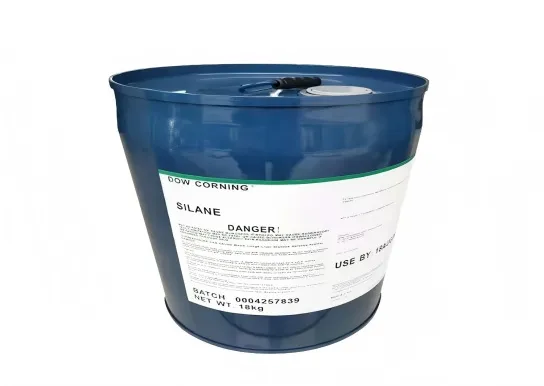
Packaging | 18kg/drum |
Dow Corning OFS-6341 Hydrophobic Silane Coupling Agent – Frequently Asked Questions (FAQ)
Q1: What is the primary function of OFS-6341 in composite formulations?
A: OFS-6341 functions as a hydrophobic silane coupling agent that enhances interfacial adhesion between inorganic fillers (e.g., silica, calcium carbonate) and hydrophobic polymer matrices (e.g., polyolefins, silicones), while simultaneously imparting water repellency and improving dispersion stability.
Q2: How is OFS-6341 typically incorporated into a manufacturing process?
A: It is commonly added during filler surface treatment (dry or slurry phase) or directly compounded into the polymer melt. Due to its reactivity, it is recommended to avoid prolonged exposure to ambient moisture prior to use and to ensure adequate mixing for uniform surface coverage.
Q3: Is OFS-6341 compatible with silicone-based systems?
A: Yes — OFS-6341 is specifically designed for compatibility with silicone elastomers and resins, where it supports improved filler integration and contributes to long-term hydrophobic performance without compromising cure kinetics or mechanical integrity.
Q4: What safety and handling precautions should be observed?
A: As with most reactive silanes, OFS-6341 should be handled in well-ventilated areas, using appropriate personal protective equipment (e.g., nitrile gloves, safety goggles). Avoid inhalation of mists or vapors, and minimize skin contact. Refer to the Safety Data Sheet (SDS) for detailed occupational hygiene guidance.
 English
 Español
 tiếng việt
 русский