English
 Español
 tiếng việt
 русский
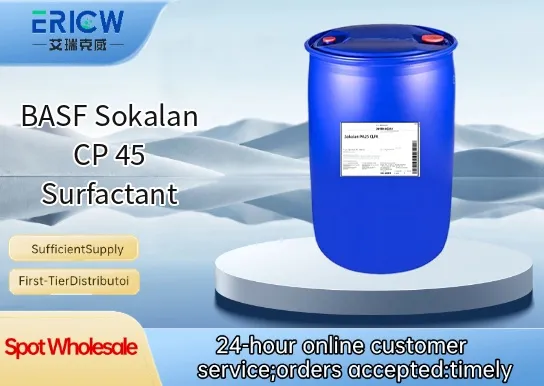
Highly effective polymeric dispersant for inorganic pigments and fillers.
Excellent stabilization of aqueous pigment dispersions across broad pH ranges (pH 4–10).
Low foaming profile, suitable for high-shear processing and industrial coating applications.
Enables improved color strength, gloss, and storage stability in waterborne systems.
Compatible with common co-binders, thickeners, and other additives in architectural and industrial coatings.
Architectural waterborne interior and exterior paints.
Industrial maintenance coatings and coil coatings.
Water-based printing inks for packaging and publication.
Construction chemicals including tile adhesives and cementitious grouts.
Specialty dispersions for functional pigments and effect pigments.
| Chemical Type | Anionic polyacrylate copolymer |
| Product Form | Aqueous solution (~45% active content) |
| Appearance | Clear to slightly opalescent, low-viscosity liquid |
| pH (1% aqueous solution) | 7.0–8.5 |
| Density (20 °C) | ~1.08–1.12 g/cm³ |
| Solubility | Completely miscible with water; compatible with common polar organic solvents |
| Primary Applications | Dispersant/stabilizer for TiO₂, carbon black, iron oxides, and calcium carbonate |
| Key Features | Polymeric architecture ensures steric + electrostatic stabilization |
Q1: What is the primary function of Sokalan CP 45 in formulations?
A: Sokalan CP 45 is a polyacrylate-based polyelectrolyte surfactant designed primarily for dispersion stabilization and rheology modification. It helps prevent particle agglomeration in aqueous systems and supports uniform pigment or filler distribution in coatings, adhesives, and construction chemicals.
Q2: Is Sokalan CP 45 compatible with common biocides and other additives?
A: Yes, Sokalan CP 45 generally exhibits good compatibility with a broad range of preservatives, defoamers, wetting agents, and co-dispersants used in industrial water-based formulations. However, compatibility should always be verified experimentally under specific formulation conditions, especially when strong oxidizing agents or highly acidic components are present.
Q3: How does Sokalan CP 45 perform under varying pH conditions?
A: As an anionic polyelectrolyte, Sokalan CP 45 shows optimal performance in neutral to alkaline environments (pH ≥ 7), where its carboxylate groups remain fully ionized. Effectiveness may decrease significantly below pH 5 due to protonation and reduced electrostatic repulsion, potentially leading to viscosity loss or reduced stabilization.
Q4: What is the typical dosage range for Sokalan CP 45 in industrial applications?
A: Dosage depends on formulation requirements, but Sokalan CP 45 is typically used at low concentrations—generally ranging from 0.1% to 2% by weight relative to the total solids or active pigment content. Optimal levels should be determined through application-specific testing to balance stabilization efficiency and cost-effectiveness.
Contact With Us:
E-mail: wangxingqiang@ericwchem.com
Have a Questions? Call Us:
Add:
Building A1, Jiete Industrial Park, Huangpu District, Guangzhou City, Guangdong Province, China