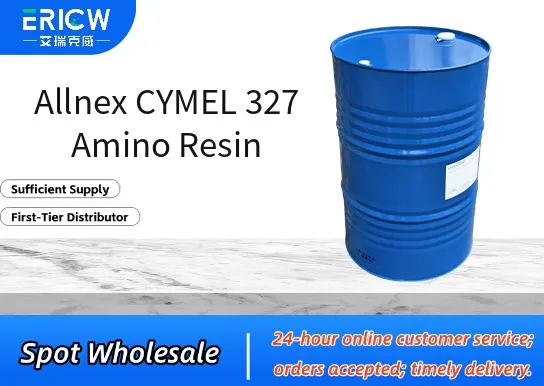
Features Of Allnex Amino Resin CYMEL
Versatile Crosslinking Performance – Combines alkylation and amino functionality for stable curing in both solvent-based and waterborne systems, with adjustable reactivity to suit diverse formulations
Eco-Friendly Formulation – Low formaldehyde emission and compliance with VOC regulations, ensuring safety and environmental sustainability.
Optimized Curing Efficiency – Fast curing at low temperatures (110–150°C), reducing energy consumption and production time while minimizing foaming.
Enhanced Material Compatibility – Compatible with hydroxyl, carboxyl, and amide-functional resins (e.g., acrylics, polyesters, alkyds), offering flexibility in formulation design.
Durability & Aesthetics – Delivers high gloss, scratch resistance, and chemical/weather resistance for long-lasting finishes.
Typical Applications Of Allnex Amino Resin CYMEL
Automotive & OEM Coatings – Ideal for primers, topcoats, and original equipment manufacturing, providing durability and UV resistance
Industrial Metal Coatings – Used in coil coatings, can coatings, and metal substrates for corrosion and abrasion resistance
Wood & Furniture Coatings – Suitable for acid-cured wood finishes, offering fast drying, adhesion, and low formaldehyde release
Low-VOC & Waterborne Systems – Supports eco-friendly coatings for architectural and industrial applications
Specifications Of Allnex Amino Resin CYMEL
| Model | Chemical Type | Recommended Application |
| CYMEL 1130 | Highly Methylated Butylated Melamine Resin | High-Solid Baking Formulations |
| CYMEL 1141 | Methylated/Isobutylated Carboxylated Melamine | Electrodeposition Primers |
| CYMEL 1158 | Butylated Melamine-Formaldehyde Crosslinker | Medium-Solid Systems |
| CYMEL 250 | Butylated Melamine-Formaldehyde Crosslinker | Automotive Coating Systems |
| CYMEL 211 | High Imino Mixed Alkylated Melamine Formaldehyde | High-Solid Coatings |
| CYMEL 328 | Methylated High Imino Melamine Crosslinker | Waterborne Industrial Coatings |
| CYMEL 325 | Methylated High Imino Melamine Crosslinker | Coil Coatings, Automotive, Industrial |
| CYMEL UI-19-I | Partially Isobutylated Urea Resin | Eco-Friendly Low-Bake Industrial Wood Finishes |
| CYMEL UI-20-E | Partially Isobutylated Urea Crosslinker | High-Performance Acid-Cured Wood Coatings |
| CYMEL UI-27-EI | Partially Isobutylated Urea Resin | High-Performance Acid-Cured Wood Coatings |
Allnex Amino Resin CYMEL – Frequently Asked Questions (FAQ)
Q1: What is the primary function of CYMEL resins in coating formulations?
A: CYMEL amino resins act as crosslinking agents that react with hydroxyl-, carboxyl-, or amide-functional polymers (e.g., acrylics, polyesters, alkyds) under heat to form a durable, thermoset network—enhancing hardness, chemical resistance, and cure speed.
Q2: Are CYMEL resins compatible with waterborne systems?
A: Yes—many CYMEL resins, including selected grades in the CYMEL portfolio, are formulated for compatibility with waterborne coatings. Performance depends on pH control, co-solvent selection, and resin hydrophobicity; formulation optimization is recommended for stable dispersion and efficient curing.
Q3: How does cure temperature affect CYMEL resin performance?
A: CYMEL resins typically require elevated temperatures (commonly 120–160 °C) to achieve full crosslinking. Lower cure temperatures may be possible with acid catalysts or modified resins, but incomplete cure can compromise film integrity and chemical resistance.
Q4: Do CYMEL resins require catalysts for optimal cure?
A: While some CYMEL resins can self-cure at high temperatures, acid catalysts (e.g., p-toluenesulfonic acid or blocked acids) are commonly used to lower the effective cure temperature and improve through-cure—especially in thick films or heat-sensitive substrates.
 English
 Español
 tiếng việt
 русский