English
 Español
 tiếng việt
 русский
High reactivity with melamine-formaldehyde and urea-formaldehyde resins for efficient crosslinking.
Excellent compatibility with acrylic, polyester, and alkyd binder systems.
Low formaldehyde emission profile, supporting compliance with stringent VOC and emissions regulations.
Consistent batch-to-batch performance and thermal stability during curing.
Enables high-gloss, durable finishes with superior hardness and chemical resistance.
Automotive OEM and refinish coatings.
Industrial coil and can coatings.
Wood furniture and panel finishes.
Appliance enamel coatings.
General-purpose industrial baked finishes.
| Chemical Type | Melamine-formaldehyde modified amino resin |
| Product Form | Liquid |
| Appearance | Clear to slightly hazy, pale yellow liquid |
| Solvent Content | Approx. 65–75% (proprietary alcohol/water blend) |
| Non-Volatile Content | 25–30% w/w at 125°C, 60 min |
| pH (10% aqueous solution) | 7.5–8.5 |
| Viscosity (Brookfield, #2 spindle, 25°C) | 50–150 cP |
| Storage Stability | ≥6 months at 5–30°C in sealed container |
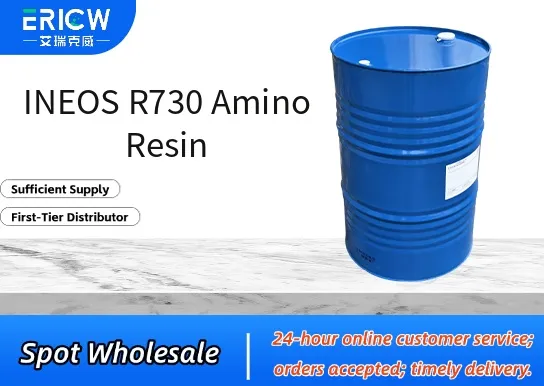
Q1: What is the primary function of INEOS R730 in coating formulations?
A: INEOS R730 is a melamine-formaldehyde amino resin designed to act as a crosslinking agent, enhancing hardness, chemical resistance, and thermal stability in thermosetting acrylic, polyester, and alkyd-based coatings.
Q2: Is INEOS R730 compatible with high-solids or low-VOC coating systems?
A: Yes, R730 is formulated for compatibility with modern high-solids and low-VOC systems. Its low free formaldehyde content and balanced reactivity support efficient curing while helping formulators meet evolving environmental and regulatory expectations.
Q3: How does INEOS R730 differ from conventional high-alkylated melamine resins?
A: R730 features a tailored alkyl chain distribution that delivers improved solubility in common organic solvents and enhanced compatibility with diverse binder systems—without sacrificing crosslinking efficiency or film clarity.
Q4: What are typical cure conditions when using INEOS R730?
A: R730 is optimized for forced-air oven curing, typically in the range of 120–160 °C. Cure time and temperature depend on film thickness, substrate type, and overall formulation balance—but full crosslinking is generally achieved within 15–30 minutes under standard industrial conditions.
Q5: Can INEOS R730 be used in can coating applications?
A: Yes—R730 is widely employed in interior and exterior can coatings where superior adhesion, corrosion resistance, and food-contact suitability (when formulated and cured appropriately) are required. Its performance aligns well with demanding beverage and food container end-use requirements.
Contact With Us:
E-mail: wangxingqiang@ericwchem.com
Have a Questions? Call Us:
Add:
Building A1, Jiete Industrial Park, Huangpu District, Guangzhou City, Guangdong Province, China