English
 Español
 tiếng việt
 русский
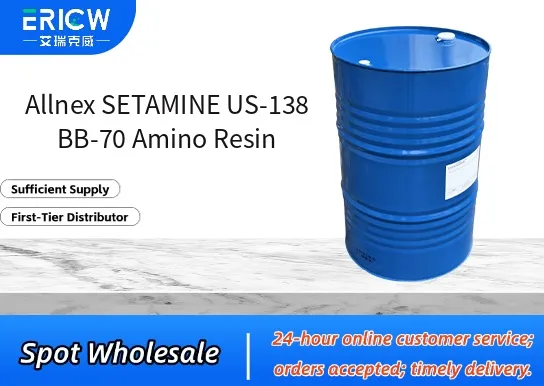
High reactivity with melamine-formaldehyde and urea-formaldehyde resins for rapid cure kinetics.
Excellent compatibility with alkyd, polyester, and acrylic binder systems in thermosetting coatings.
Low formaldehyde emission profile, supporting compliance with stringent VOC and emissions regulations.
Superior storage stability in solvent-based formulations at ambient temperature.
Enables high-gloss, durable finishes with enhanced chemical and scratch resistance.
Automotive OEM and refinish topcoats requiring fast bake cycles and high appearance quality.
Industrial metal coatings for appliances, furniture, and building panels.
Can and coil coatings demanding excellent corrosion resistance and film integrity.
General-purpose baking enamels for metal substrates in diverse manufacturing sectors.
| Chemical Type | Melamine-formaldehyde amino resin (partially etherified) |
| Product Form | Liquid |
| Appearance | Clear to slightly hazy, colorless to pale yellow liquid |
| Solvent System | Isobutanol / n-butanol blend |
| Non-Volatile Content (wt%) | 68–72% |
| Viscosity (25°C, mPa·s) | 150–350 |
| Density (25°C, g/cm³) | 0.92–0.95 |
| pH (10% solution in water) | 7.5–8.5 |
Q1: What is the primary function of SETAMINE US-138 BB-70 in coating formulations?
A: SETAMINE US-138 BB-70 is a low-viscosity, highly reactive amino resin designed primarily as a crosslinker for hydroxyl-functional resins—especially acrylics and polyesters—in thermosetting coatings. It enhances cure speed, hardness, chemical resistance, and gloss retention under conventional or low-bake conditions.
Q2: Is this resin suitable for low-VOC or high-solids coating systems?
A: Yes—SETAMINE US-138 BB-70 features low inherent viscosity and minimal free formaldehyde content, making it well-suited for high-solids, solvent-borne industrial coatings where VOC reduction and formulation efficiency are priorities. It does not require high levels of co-solvents to achieve stable blends.
Q3: How does BB-70 differ from other SETAMINE resins like BB-40 or BB-90?
A: BB-70 offers a balanced reactivity profile—higher than BB-40 (which is optimized for ambient or very mild cure) but lower than BB-90 (designed for rapid high-temperature cure). This makes BB-70 especially effective in mid-temperature curing applications (e.g., 120–160 °C), where robust performance and processing flexibility are required.
Q4: What catalysts are typically recommended to optimize its cure performance?
A: Acid catalysts such as p-toluenesulfonic acid (pTSA), dinonylnaphthalene sulfonic acid (DNNSA), or blocked acid systems are commonly used. Catalyst selection and dosage depend on the base resin, film thickness, and target cure schedule—formulators generally adjust to achieve full crosslink density without premature gelation or loss of pot life.
Q5: Can SETAMINE US-138 BB-70 be used in waterborne systems?
A: While primarily developed for solvent-borne systems, BB-70 can be incorporated into hybrid or water-reducible formulations with appropriate emulsification or co-solvent strategies. However, its compatibility and stability in fully aqueous dispersions should be verified experimentally, as hydrolytic sensitivity may vary depending on pH and ionic environment.
Contact With Us:
E-mail: wangxingqiang@ericwchem.com
Have a Questions? Call Us:
Add:
Building A1, Jiete Industrial Park, Huangpu District, Guangzhou City, Guangdong Province, China