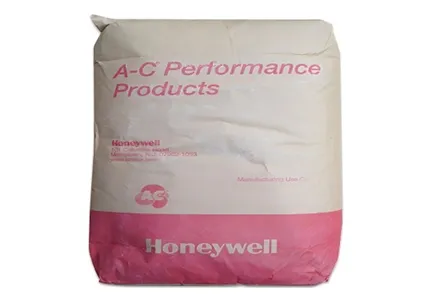
Honeywell A-C 6A is a low-density polyethylene homopolymer wax with high crystallinity and low molecular weight. It delivers moderate external lubrication for better processing and surface shine. Applied across plastics, PVC, masterbatches, coatings, and inks, it enhances processing efficiency, finish, and abrasion resistance while meeting FDA safety and eco-friendly standards.

High Transparency: Preserves clarity in clear applications such as PVC.
Lubrication: Provides excellent external lubrication, aiding processing and mold release.
Gloss Enhancement: Boosts surface shine and visual appeal.
Wear Resistance: Strengthens material resistance to scratches and abrasion.
Eco-Friendly: Complies with FDA standards, ideal for food packaging and pharmaceuticals.
Plastics: Used in polyolefins, styrene, and PVC to boost lubrication and glossiness.
Masterbatches: Functions as a pigment dispersant, improving dispersion and color strength.
Coatings: Applied in solvent-based coatings for enhanced scratch resistance and smoothness.
Inks: Employed in liquid solvent-based inks to increase abrasion resistance and gloss control.
| Chemical Name | Low-Density Polyethylene Homopolymer Wax |
| Appearance | White powder or granules |
| Melting Point | 106℃ |
| Density | 0.92 g/cm³ |
| Acid Value | Nil |
| Hardness | 3-5 dmm |
| Viscosity (140℃) | 375 cps |
| Bulk Density | 483 kg/m³ |
| Packaging | 25kg/bag |
| Shelf Life | 12 months |
| Origin | USA |
Q1: What is the primary functional role of A-C 6A in polymer and coating formulations?
A: A-C 6A functions primarily as a processing aid and surface modifier—improving melt flow, reducing extrusion torque, enhancing dispersion of pigments and fillers, and imparting controlled slip and anti-blocking properties to finished films and molded parts.
Q2: Is A-C 6A compatible with common thermoplastics such as polyolefins, PVC, and engineering resins?
A: Yes—A-C 6A exhibits broad compatibility with polyolefins (PP, PE), PVC, styrenics, and many engineering thermoplastics. Its low molecular weight and linear polyethylene structure support good miscibility during melt processing without phase separation under typical operating conditions.
Q3: How does A-C 6A differ from oxidized polyethylene waxes like A-C 617 or A-C 540?
A: Unlike oxidized grades, A-C 6A is a non-polar, unmodified polyethylene wax with no carboxylic or hydroxyl functionality. This gives it higher hydrophobicity, lower surface energy, and superior compatibility in non-polar systems—but less polarity-driven adhesion or dispersing power in polar matrices.
Q4: What are typical dosage ranges for A-C 6A in masterbatch and finished compound applications?
A: Dosage depends on formulation requirements and desired effect, but A-C 6A is typically used at low concentrations—generally ranging from 0.1% to 2% by weight—where higher levels may be applied selectively for enhanced lubrication or surface migration effects.
Contact With Us:
E-mail: wangxingqiang@ericwchem.com
Have a Questions? Call Us:
Add:
Building A1, Jiete Industrial Park, Huangpu District, Guangzhou City, Guangdong Province, China
 English
 Español
 tiếng việt
 русский