English
 Español
 tiếng việt
 русский
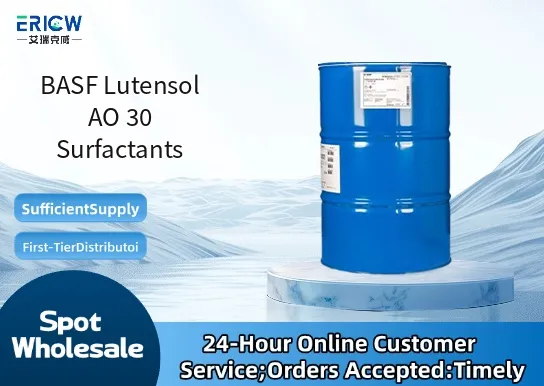
Nonionic alcohol ethoxylate with balanced hydrophilic-lipophilic character for versatile performance across pH and temperature ranges.
Excellent wetting, emulsifying, and solubilizing properties in aqueous systems.
Low foaming profile suitable for high-shear and industrial cleaning applications.
Biodegradable and formulated to meet current regulatory requirements for sustainable industrial formulations.
Good compatibility with anionic, cationic, and other nonionic surfactants in complex formulations.
Industrial and institutional cleaners (I&I), including hard surface and floor cleaners.
Agrochemical adjuvants for improving active ingredient dispersion and foliar uptake.
Textile auxiliaries such as scouring and dyeing assistants.
Paints and coatings additives for pigment dispersion and stabilization.
Personal care formulations requiring mild, low-foam solubilizers (e.g., cleansing bases).
| Chemical Type | Linear alcohol ethoxylate (C13–C15, ~30 mol EO) |
| Product Form | Liquid |
| Appearance | Pale yellow to amber viscous liquid |
| pH (1% aqueous solution) | 5.5–7.0 |
| Cloud Point (1% aqueous solution) | ~65–75 °C |
| Active Content | ≥98.0% |
| Odor | Characteristic mild, fatty alcohol ether odor |
| Solubility | Freely soluble in water and common organic solvents |
Q1: What is the primary chemical nature of Lutensol AO 30?
A: Lutensol AO 30 is a nonionic surfactant based on alkoxylated linear alcohols, specifically derived from C13–C15 fatty alcohols ethoxylated with an average of approximately 30 moles of ethylene oxide per mole of alcohol. Its structure provides balanced hydrophilicity and surface activity suitable for demanding industrial applications.
Q2: Is Lutensol AO 30 suitable for low-foaming cleaning formulations?
A: Yes — due to its high ethoxylation degree and linear alcohol backbone, Lutensol AO 30 delivers effective detergency with inherently low foaming characteristics, making it well-suited for CIP (clean-in-place) systems, industrial laundry, and high-speed automated cleaning processes where foam control is critical.
Q3: How does temperature affect the performance of Lutensol AO 30 in aqueous solutions?
A: Lutensol AO 30 exhibits good solubility and stability across a broad temperature range. It remains effective in cold-water applications and maintains emulsifying and dispersing performance at elevated temperatures typical in industrial cleaning or processing operations, without significant cloud point limitations under standard use conditions.
Q4: Can Lutensol AO 30 be used in combination with ionic surfactants?
A: Yes — as a nonionic surfactant, Lutensol AO 30 is generally compatible with anionic, cationic, and amphoteric surfactants. Synergistic effects are often observed in blended systems, particularly when combined with anionic builders or co-surfactants to enhance wetting, soil suspension, and formulation stability.
Q5: What are typical dosage guidelines for Lutensol AO 30 in industrial cleaning concentrates?
A: Dosage depends on formulation requirements and application intensity, but Lutensol AO 30 is typically used at low concentrations — generally ranging from 0.1% to 2% by weight in ready-to-use solutions — to achieve optimal cleaning efficiency while maintaining cost-effectiveness and environmental compatibility.
Contact With Us:
E-mail: wangxingqiang@ericwchem.com
Have a Questions? Call Us:
Add:
Building A1, Jiete Industrial Park, Huangpu District, Guangzhou City, Guangdong Province, China