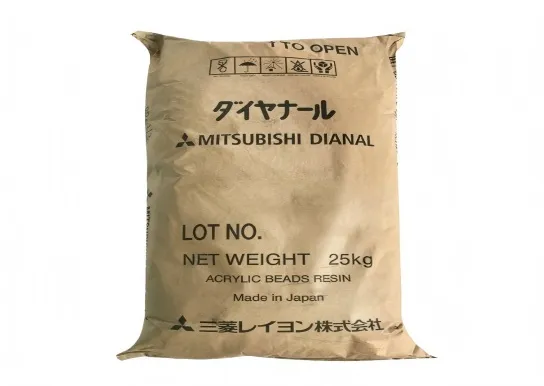
Features Of Mitsubishi Chemical BR-80 Thermoplastic Acrylic Resin
High-Quality Aluminum Powder Adaptability - Outstanding dispersibility and orientation of aluminum powder, ensuring uniform and long-lasting metallic luster of coatings
Superior Weather Resistance Protection - Excellent resistance to UV and atmospheric aging, not easy to lose luster or discolor during long-term outdoor use
Strong Solvent Tolerance - Resists erosion of various organic solvents, improving chemical stability and service life of coatings
Efficient High-Temperature Film Formation - Suitable for high-temperature baking process, fast film formation and dense film layer, shortening production turnover
Typical Applications Of Mitsubishi Chemical BR-80 Thermoplastic Acrylic Resin
Automotive Aluminum Powder Baking Paint - Suitable for decorative and protective coating of aluminum powder on core parts such as automotive bodies and wheels
Automotive Parts Coating - Used for the preparation of high-temperature baking aluminum powder coatings for automotive exterior trim parts and engine compartment components
Motorcycle Metallic Coating - Adaptable for high-gloss metallic texture baking paint on motorcycle bodies, fuel tanks and other parts
High-End Hardware Metallic Paint - Used for high-temperature baking metallic coatings of high-end hardware accessories and precision instrument casings
Specifications Of Mitsubishi Chemical BR-80 Thermoplastic Acrylic Resin
| Chemical Type | Thermoplastic acrylic resin |
| Technology Type | High-temperature baking type, solvent-based |
| Appearance | Transparent liquid |
| Solvent Composition | Toluene/Butanol mixed system |
| Solids Content | 50 ± 1 % |
| Color (Gardner) | ≤ 1 |
| Viscosity (25℃, Gardner) | U-W |
| Acid Value | 2 - 5 mg KOH/g |
| OH Value (based on solids) | None |
| Glass Transition Temperature (Tg) | Approx. 45-55 ℃ |
Mitsubishi Chemical BR-85 Thermoplastic Acrylic Resin – Frequently Asked Questions (FAQ)
Q1: What are the primary advantages of BR-85 compared to other thermoplastic acrylic resins?
A: BR-85 offers excellent clarity, UV stability, and melt processability, making it particularly suitable for demanding extrusion and injection molding applications where optical performance and thermal consistency are critical. Its balanced molecular weight distribution supports good flow characteristics without excessive degradation during processing.
Q2: Is BR-85 compatible with common engineering plastics such as ABS or PC in alloy formulations?
A: Yes, BR-85 demonstrates good compatibility with several engineering thermoplastics—including ABS and certain polycarbonate grades—enabling its use in transparent or high-gloss alloy systems. Compatibility should be verified experimentally for each specific formulation due to sensitivity to thermal history and additive interactions.
Q3: What types of processing methods is BR-85 optimized for?
A: BR-85 is specifically engineered for conventional thermoplastic processing techniques, including injection molding, extrusion, and sheet thermoforming. It exhibits low melt viscosity at standard processing temperatures and minimal thermal degradation, supporting stable output and surface quality in high-speed production environments.
Q4: Can BR-85 be used in applications requiring FDA compliance for indirect food contact?
A: BR-85 is not pre-certified for food-contact applications, but its composition—based on polymerized methyl methacrylate—is consistent with substances permitted under general FDA guidelines for indirect food contact when formulated and processed appropriately. End-use compliance requires full regulatory evaluation by the finished product manufacturer.
 English
 Español
 tiếng việt
 русский