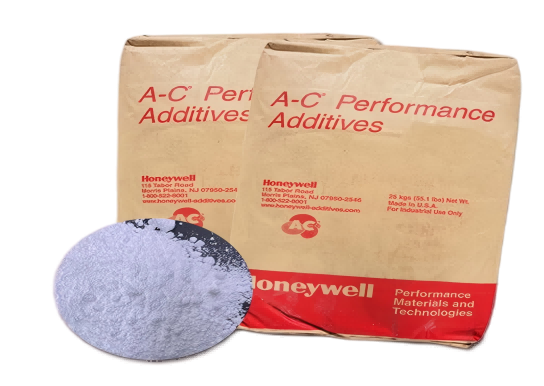
Features Of Honeywell Polyethylene LDPE Wax Powder A-C 16
Premium Lubrication: Minimizes friction to improve processing efficiency and finished surface quality.
Uniform Dispersion: Unique granular structure ensures even distribution and enhanced material compatibility.
Broad Applicability: Suitable for PVC extrusion, injection molding, and calendering processes.
Melt Flow Enhancement: Improves melt fluidity for optimized processing performance.
Cost Efficiency: Low dosage achieves ideal results, reducing production costs.
Eco-Safe: Complies with environmental standards, non-toxic for industrial use.
Typical Applications Of Honeywell Polyethylene LDPE Wax Powder A-C 16
PVC Extrusion: Enhances surface finish of profiles, pipes, and tubing.
Injection Molding: Acts as external lubricant for improved mold release and flow.
Calendering: Improves surface gloss and uniformity of PVC films and sheets.
Plastic Compounding: Provides versatile lubrication for color masterbatches and filled compounds.
Specifications Of Honeywell Polyethylene LDPE Wax Powder A-C 16
Chemical Type | Low-Density Polyethylene (LDPE) Homopolymer |
Appearance | Granular |
Brand | Honeywell |
Model | A-C 16 |
Density | 0.93 g/cm³ |
Melting Point | 101℃ |
Viscosity (@140°C) | 200 mPa.s |
Packaging | 25 kg/bag |
Origin | USA |
Honeywell Polyethylene LDPE Wax Powder A-C 16 – Frequently Asked Questions (FAQ)
Q1: What is the primary function of A-C 16 in polymer and coating formulations?
A: A-C 16 functions primarily as a processing aid and surface modifier, providing lubricity, improved melt flow, and enhanced slip and abrasion resistance. It is commonly used to reduce extrusion torque, improve dispersion of pigments or fillers, and impart a controlled matte or satin finish.
Q2: Is A-C 16 compatible with common thermoplastics and thermosets?
A: Yes, A-C 16 exhibits broad compatibility with polyolefins (e.g., PP, HDPE, LDPE), PVC, ABS, polystyrene, and many acrylic and polyester-based coatings. Its low molecular weight and non-polar nature support uniform dispersion in hydrophobic systems.
Q3: How does A-C 16 differ from higher-melting polyethylene waxes like A-C 617 or A-C 629?
A: A-C 16 is a lower-melting, softer LDPE-based wax powder with a broader molecular weight distribution, making it particularly effective for early-melt applications such as internal lubrication during compounding or surface bloom in coatings. In contrast, higher-melting waxes are typically selected for high-temperature stability or harder surface effects.
Q4: What is the recommended method for incorporating A-C 16 into solid polymer blends?
A: For optimal dispersion, A-C 16 is best added during the masterbatch stage or early in the compounding process—typically alongside resins and other additives—using high-shear mixing at temperatures above its softening point. Pre-blending with carrier resin or using liquid-assisted feeding may further enhance homogeneity.
 English
 Español
 tiếng việt
 русский