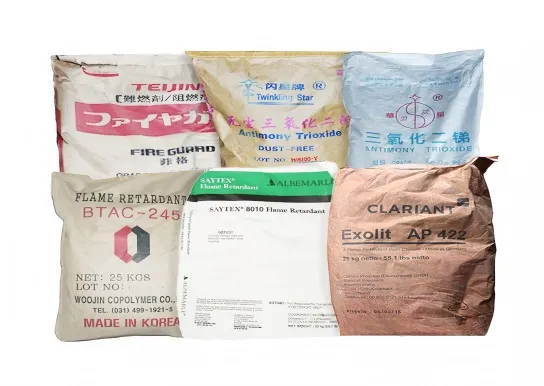
Features Of ADEKA FP-2100JC Flame Retardants
Enhanced Thermal Resistance - Withstands higher processing temperatures than standard grades
Optimized Char Formation - Creates robust protective layer during combustion
Material Integrity - Preserves base polymer flexibility and strength
Eco-Advanced Formula - Halogen-free with minimal smoke emission
Processing Versatility - Compatible with various molding techniques
Typical Applications Of ADEKA FP-2100JC Flame Retardants
High-Temperature Wire Coatings - Industrial cable insulation systems
Automotive Underhood - Engine compartment wiring and components
Electrical Enclosures - Heat-resistant protective casings
Industrial Tubing - Flame-retardant fluid transfer systems
Building Safety Systems - Fire-resistant structural elements
Specifications Of ADEKA FP-2100JC Flame Retardants
| Chemical Base | Phosphorus-nitrogen complex |
| Thermal Stability | 280°C+ continuous exposure |
| Char Expansion | 3-5x original volume |
| Recommended Loading | 22-38% by weight |
| Density | 1.08-1.12 g/cm³ |
| Particle Structure | Low-dust spherical |
ADEKA FP-2500S Flame Retardants – Frequently Asked Questions (FAQ)
Q1: What is the primary chemical nature of ADEKA FP-2500S?
A: ADEKA FP-2500S is a phosphorus-based, non-halogenated flame retardant formulated as a liquid additive, designed for compatibility with various thermoplastic and thermoset polymer systems.
Q2: In which polymer systems is ADEKA FP-2500S most commonly used?
A: It is widely applied in engineering plastics such as polyamide (PA6, PA66), polybutylene terephthalate (PBT), and polycarbonate blends, particularly where halogen-free flame retardancy and good mechanical property retention are required.
Q3: How is ADEKA FP-2500S typically incorporated into formulations?
A: It is generally added via melt compounding or direct mixing during extrusion or injection molding. Due to its liquid form and low volatility, it offers good dispersion and process stability without requiring pre-drying or special handling precautions.
Q4: Does ADEKA FP-2500S affect the color or clarity of final parts?
A: When properly compounded, FP-2500S exhibits excellent color stability and minimal impact on transparency—making it suitable for applications where aesthetic performance remains critical alongside flame retardancy.
Q5: Is ADEKA FP-2500S compatible with common polymer additives such as stabilizers and impact modifiers?
A: Yes, FP-2500S demonstrates broad compatibility with conventional thermal stabilizers, UV absorbers, and elastomeric impact modifiers, though compatibility testing under actual processing conditions is recommended for each specific formulation.
 English
 Español
 tiếng việt
 русский