English
 Español
 tiếng việt
 русский
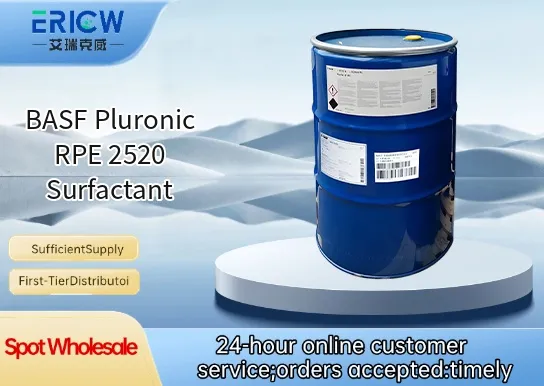
Nonionic triblock copolymer based on propylene oxide (PO) and ethylene oxide (EO) with reactive end-capping for enhanced formulation stability.
Low foaming profile suitable for high-shear and industrial cleaning processes where foam control is critical.
Excellent wetting and dispersing performance in aqueous systems across a broad pH range (pH 4–11).
Improved thermal and hydrolytic stability compared to conventional Pluronic® grades due to ether-linked reactive end groups.
Readily biodegradable under OECD 301B conditions, supporting sustainable product stewardship goals.
Industrial and institutional (I&I) hard-surface cleaners, including alkaline degreasers and sanitizing formulations.
Agrochemical adjuvants for enhancing active ingredient solubilization and foliar spray retention.
Specialty coatings and ink additives to improve pigment dispersion and substrate wetting.
Oilfield demulsifiers and pipeline flow improvers in low-temperature, high-water-cut environments.
Pharmaceutical and cosmetic emulsion stabilizers where non-ionic, low-irritancy surfactants are required.
| Chemical Type | Reactive PO/EO triblock copolymer (RPE series) |
| Product Form | Liquid |
| Appearance | Pale yellow to amber, clear to slightly hazy liquid at 25°C |
| pH (1% aqueous solution) | 5.5–7.5 |
| Cloud Point (1% solution) | 68–74°C |
| Hydroxyl Number (mg KOH/g) | 38–44 |
| Viscosity (25°C, cP) | 350–550 |
| Water Solubility | Completely miscible in water at room temperature |
Q1: What is the primary functional role of Pluronic RPE 2520 in formulations?
A: Pluronic RPE 2520 is a nonionic triblock copolymer surfactant designed primarily for solubilization, emulsification, and stabilization of hydrophobic actives in aqueous systems. Its balanced hydrophilic-lipophilic character supports performance in low-foaming, high-solids, or temperature-sensitive applications.
Q2: Is Pluronic RPE 2520 suitable for use in personal care and cosmetic products?
A: Yes — Pluronic RPE 2520 is widely used in rinse-off and leave-on cosmetic formulations due to its mildness, low irritation potential, and compatibility with common preservatives and electrolytes. It is typically used at low concentrations to enhance solubilization of oils, fragrances, or UV filters without compromising clarity or stability.
Q3: How does Pluronic RPE 2520 perform under elevated temperature or varying pH conditions?
A: As a polyether-based surfactant, Pluronic RPE 2520 exhibits good thermal stability and maintains functionality across a broad pH range (approximately pH 3–11). It remains effective in warm-process manufacturing and shows minimal degradation during standard storage and handling conditions.
Q4: Can Pluronic RPE 2520 be used in combination with ionic surfactants?
A: Yes — Pluronic RPE 2520 is generally compatible with anionic, cationic, and amphoteric surfactants. Its nonionic nature helps mitigate harshness and improve foam quality or viscosity response in mixed-surfactant systems, though formulation-specific compatibility testing is recommended to confirm stability and performance.
Contact With Us:
E-mail: wangxingqiang@ericwchem.com
Have a Questions? Call Us:
Add:
Building A1, Jiete Industrial Park, Huangpu District, Guangzhou City, Guangdong Province, China