English
 Español
 tiếng việt
 русский
Nonionic surfactant based on ethoxylated linear primary alcohols with optimized hydrophilic-lipophilic balance (HLB ≈ 13.5).
Excellent wetting, emulsifying, and solubilizing performance in aqueous systems across a broad pH range.
Low foaming profile suitable for high-shear and industrial cleaning applications.
Good biodegradability and favorable ecotoxicological profile per OECD test guidelines.
Stable in hard water and compatible with common anionic, cationic, and other nonionic surfactants.
Industrial and institutional cleaners (e.g., floor cleaners, degreasers, glass cleaners).
Agrochemical formulations, including suspension concentrates (SC) and emulsifiable concentrates (EC).
Textile auxiliaries for scouring, dye leveling, and dispersion stabilization.
Paints and coatings as a wetting agent and co-emulsifier in acrylic and styrene-butadiene dispersions.
Home care products such as automatic dishwashing liquids and heavy-duty laundry detergents.
| Chemical Type | Nonionic: Alcohol ethoxylate (C13–C15 linear primary alcohol, avg. 10 EO units) |
| Product Form | Liquid |
| Appearance | Pale yellow to colorless, clear to slightly opalescent liquid |
| pH (1% aqueous solution, 20 °C) | 5.5–7.0 |
| Active Content (wt. %) | ≥ 48.0% |
| Cloud Point (1% aqueous solution) | ≈ 62–66 °C |
| Density (20 °C) | 1.02–1.04 g/cm³ |
| Viscosity (20 °C) | 150–350 mPa·s |
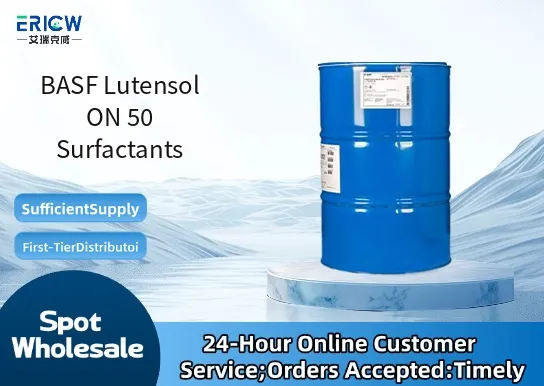
Q1: What is the primary chemical nature of Lutensol ON 50?
A: Lutensol ON 50 is a nonionic surfactant based on linear alcohol ethoxylates, specifically derived from C13–15 alcohols with an average of approximately 50 moles of ethylene oxide per molecule, offering balanced hydrophilicity and surface activity.
Q2: In which types of industrial cleaning formulations is Lutensol ON 50 commonly used?
A: It is widely employed in heavy-duty liquid detergents, metal cleaning agents, and alkaline soak cleaners where high foaming stability, grease emulsification, and compatibility with builders and other surfactants are required.
Q3: How does temperature affect the performance of Lutensol ON 50 in aqueous systems?
A: As a high-EO ethoxylate, it exhibits good cold-water solubility and remains effective across a broad temperature range; however, its cloud point is relatively high, supporting stable performance in warm to hot cleaning processes without premature phase separation.
Q4: Is Lutensol ON 50 compatible with common anionic and amphoteric surfactants?
A: Yes — it demonstrates excellent compatibility with anionic surfactants such as LAS and AES, as well as amphoteric types like betaines, enabling synergistic formulation of high-performance cleaning systems without precipitation or viscosity instability.
Q5: What are key handling and storage recommendations for Lutensol ON 50?
A: Store in tightly sealed containers at temperatures between 5 °C and 30 °C, away from direct sunlight and strong oxidizing agents; avoid prolonged exposure to freezing conditions, as repeated freeze-thaw cycles may affect physical consistency and require gentle rehomogenization before use.
Contact With Us:
E-mail: wangxingqiang@ericwchem.com
Have a Questions? Call Us:
Add:
Building A1, Jiete Industrial Park, Huangpu District, Guangzhou City, Guangdong Province, China