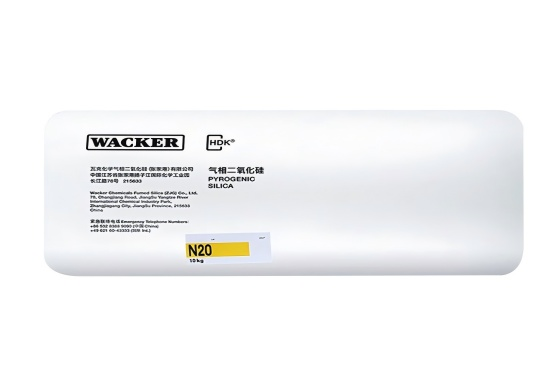
Features Of WACKER Hydrophilic Fumed Silica HDK N20
High Purity: >99.8% SiO₂ content (DIN EN ISO 3262-19)
Rheology Control: Effective thickener for paints/adhesives
Food Safety: Compliant with food contact applications
Surface Area: 170-230 m²/g (DIN ISO 9277)
Moisture Resistance: <1.5% water content (105℃)
Easy Dispersion: <0.04% residue (>40μm sieve)
Typical Applications Of WACKER Hydrophilic Fumed Silica HDK N20
Food Additive: Anti-caking agent in powders
Coatings: Thickener for EP/UP/PU resins
Silicone Rubber: Reinforcing filler for HTV/RTV
Electronics: Battery gel component
Inks: Rheology modifier for printing inks
Specifications Of WACKER Hydrophilic Fumed Silica HDK N20
| Silica content | DIN EN ISO 3262-19 | >99.8% |
| Loss on ignition (1000°C/2h) | DIN EN ISO 3262-19 | <2% |
| Silica density | DIN 51757 | ~2.2 g/cm³ |
| Refractive index | - | 1.46 |
| Silanol group density | - | 2 SiOH/nm² |
| BET surface area | DIN ISO 9277/DIN 66132 | 170-230 m²/g |
| pH (4% dispersion) | DIN EN ISO 787-9 | 3.8-4.3 |
| Bulk density | DIN EN ISO 787-11 | ~40 g/l |
| Loss on drying (105°C,2h) | DIN EN ISO 787-2 | <1.5% |
| Residue on sieve (>40μm) | DIN EN ISO 787-18 | <0.04% |
WACKER Hydrophilic Fumed Silica HDK N20 – Frequently Asked Questions (FAQ)
Q1: What is the primary functional role of HDK N20 in liquid systems?
A: HDK N20 acts primarily as a rheology modifier—providing thixotropic behavior, anti-sagging properties, and improved suspension stability in low-viscosity formulations such as coatings, adhesives, and sealants.
Q2: How does HDK N20 differ from hydrophobic fumed silica grades?
A: Unlike hydrophobic grades, HDK N20 retains surface silanol groups, making it readily dispersible in polar media (e.g., water, alcohols, glycols) and compatible with hydrophilic polymer matrices. It does not require pre-treatment for wetting in aqueous or protic systems.
Q3: What dispersion methods are recommended to achieve optimal performance?
A: Efficient dispersion typically requires high-shear mixing (e.g., rotor-stator homogenizers or dissolvers) and may benefit from controlled addition—either as a dry powder into the liquid phase or as a pre-wetted slurry—to minimize agglomeration and maximize network formation.
Q4: Is HDK N20 suitable for use in food-contact or pharmaceutical applications?
A: HDK N20 is manufactured to high-purity standards and is commonly used in selected food-contact and pharmaceutical auxiliary applications where regulatory compliance is verified by the end-formulator. Users must confirm suitability based on their specific regulatory framework and intended use.
Q5: How does storage condition affect the handling and performance of HDK N20?
A: HDK N20 should be stored in a cool, dry environment, protected from moisture and contamination. Prolonged exposure to ambient humidity may lead to slight agglomeration, though its hydrophilic nature ensures re-dispersibility under standard processing conditions.
 English
 Español
 tiếng việt
 русский