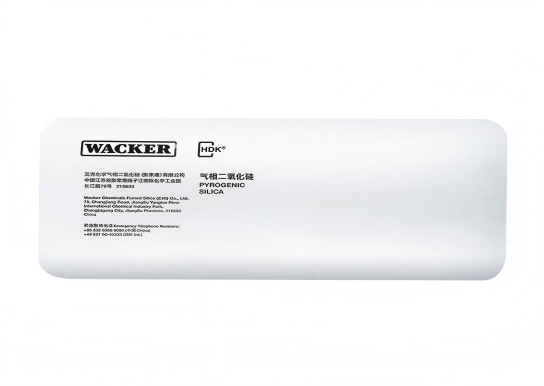
Features Of WACKER Hydrophilic Fumed Silica HDK N20D
High Purity: >99.8% SiO₂ content with low moisture (<1.5%)
Rheology Control: Acts as a thickening/thixotropic agent in organic systems
Fast Incorporation: Higher bulk density vs. non-densified grades for quicker mixing
pH Stability: 3.8-4.3 in 4% aqueous dispersion (DIN EN ISO 787-9)
Typical Applications Of WACKER Hydrophilic Fumed Silica HDK N20D
Coatings/Inks: Anti-settling agent in solvent-based formulations
Adhesives: Improves viscosity stability in sealants
Cosmetics: Flow enhancer in personal care products (INCI: Silica)
Industrial Resins: Thickener for unsaturated polyesters
Specifications Of WACKER Hydrophilic Fumed Silica HDK N20D
Silica Content | DIN EN ISO 3262-19 | >99.8% |
Loss on Ignition | DIN EN ISO 3262-19 | <2% |
Silica Density | DIN 51757 | Approximately 2.2g/cm³ |
Refractive Index | - | 1.46 |
Silane Alcohol Group Density | - | 2 SiOH/nm² |
WACKER Hydrophilic Fumed Silica HDK N20D – Frequently Asked Questions (FAQ)
Q1: What distinguishes HDK® N20D from other hydrophilic fumed silicas in the HDK® series?
A: HDK® N20D is specifically engineered for balanced rheological control and efficient thickening in low-viscosity systems. It offers a moderate specific surface area (~200 m²/g) and optimized particle structure, delivering strong thixotropy with relatively low dosage requirements—making it especially suitable for solvent-based coatings, adhesives, and sealants where sedimentation resistance and sag resistance are critical.
Q2: How should HDK® N20D be dispersed to achieve optimal performance?
A: Effective dispersion requires high-shear mixing—such as rotor-stator homogenizers or three-roll mills—to fully deagglomerate the fumed silica network. Pre-wetting with a portion of the liquid phase (e.g., solvent or resin) prior to incorporation helps minimize dusting and improves wetting efficiency. Avoid low-shear stirring alone, as it may leave undispersed clusters that compromise transparency or mechanical properties.
Q3: Is HDK® N20D compatible with silicone-based systems?
A: Yes, HDK® N20D is widely used in RTV and HTV silicone formulations to provide reinforcement and rheology control. Its hydrophilic surface interacts well with polar groups in silicone polymers, supporting stable viscosity build-up and improved green strength before curing—without interfering with typical platinum- or peroxide-catalyzed crosslinking mechanisms.
Q4: Can HDK® N20D be used in food-contact or pharmaceutical applications?
A: HDK® N20D is not certified for direct food contact or pharmaceutical use. While it meets general industrial purity specifications, it is not manufactured or qualified under food-grade (e.g., FDA 21 CFR or EFSA) or pharmacopoeial (e.g., USP/EP) regulatory frameworks. For such applications, WACKER offers dedicated grades like HDK® N20S, which comply with relevant regulatory requirements.
 English
 Español
 tiếng việt
 русский