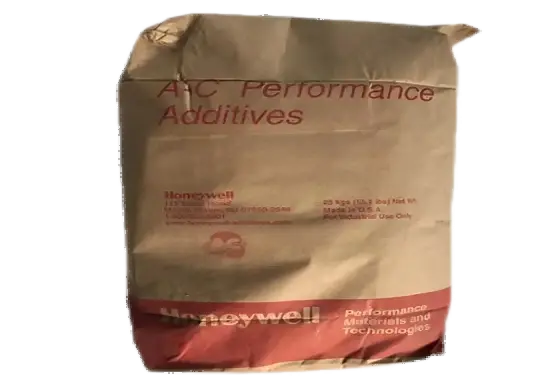
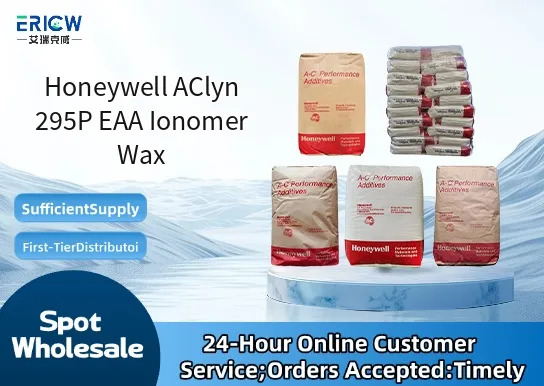
Features Of Honeywell Acrylic Acid Copolymers A-C Wax Powder
Enhanced Adhesion Performance: Improves bonding strength for various adhesive types and coating applications.
Superior Material Compatibility: Works effectively with both polar and non-polar materials across multiple applications.
Excellent Dispersion Properties: Ensures uniform color distribution and consistent performance in coatings and inks.
Surface Quality Optimization: Enhances smoothness, wear resistance and durability of finished products.
Versatile Formulation: Suitable for hot melt, water-based adhesives and various coating systems.
Typical Applications Of Honeywell Acrylic Acid Copolymers A-C Wax Powder
Adhesive Systems: Enhances performance in both hot melt and water-based adhesive formulations.
Coating Applications: Improves adhesion, wear resistance and surface quality in protective and decorative coatings.
Packaging Solutions: Optimizes performance in packaging adhesives and protective films.
Industrial Materials: Used in composite materials, textiles and other specialized applications.
Specifications Of Honeywell Acrylic Acid Copolymers A-C Wax Powder
| Model | Chemical Type | Acid Value (mg KOH/g) | Melting Point (°C) | Density (g/cm³) |
| A-C 580 | Ethylene-Acrylic Acid (EAA) Copolymer | 20 | 103 | 0.93 |
| A-C 540A | Ethylene-Acrylic Acid (EAA) Copolymer | 45 | 98 | 0.93 |
| A-C 540 | Ethylene-Acrylic Acid (EAA) Copolymer | 40 | 101 | 0.93 |
| A-C 5180 | Ethylene-Acrylic Acid (EAA) Copolymer | 60 | 95 | 0.94 |
| A-C 5120 | Ethylene-Acrylic Acid (EAA) Copolymer | 120 | 100 | 0.94 |
Honeywell Acrylic Acid Copolymers A-C Wax Powder – Frequently Asked Questions (FAQ)
Q1: What is the primary functional role of A-C Wax Powder in coating and ink formulations?
A: A-C Wax Powder functions primarily as a surface modifier to enhance slip, abrasion resistance, and matting performance. Its acrylic acid copolymer structure provides good compatibility with polar resin systems while delivering controlled migration to the film surface during drying or curing.
Q2: How does A-C Wax Powder differ from traditional polyethylene or polypropylene waxes?
A: Unlike non-polar hydrocarbon waxes, A-C Wax Powder contains acrylic acid-derived polar groups that improve dispersibility in waterborne and high-polarity solventborne systems. This enhances stabilization in emulsions and reduces the risk of bloom or haze in clear coats.
Q3: Is A-C Wax Powder suitable for use in water-based formulations?
A: Yes — it is specifically designed for compatibility with waterborne acrylics, polyurethanes, and hybrid dispersions. Pre-dispersion via high-shear mixing or milling is recommended to achieve optimal particle deagglomeration and uniform distribution.
Q4: What is the typical dosage range for A-C Wax Powder in industrial coatings?
A: Dosage depends on formulation requirements and desired performance level, but it is typically used at low concentrations — generally ranging from 0.1% to 2% by weight relative to total solids — with optimization guided by application-specific testing.
 English
 Español
 tiếng việt
 русский