English
 Español
 tiếng việt
 русский
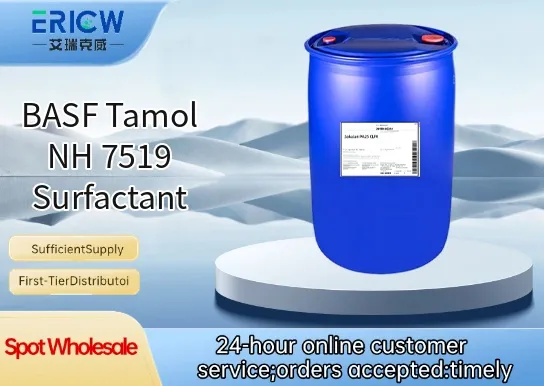
High-performance anionic dispersant based on naphthalene formaldehyde condensate (NFC) chemistry.
Excellent colloidal stabilization for inorganic pigments and fillers in aqueous systems.
Low foaming profile, suitable for high-shear and recirculating industrial processes.
Good compatibility with a broad range of water-based resins, including acrylics, styrene-acrylics, and PVA.
Enhanced wetting and rheology control without compromising gloss or film integrity.
Architectural and industrial waterborne paints and coatings.
Concrete admixtures and cement-based grouts.
Ceramic tile adhesives and self-leveling underlayments.
Water-based pigment concentrates (colorants) and inkjet ink formulations.
Mineral slurries and industrial cleaning concentrates.
| Chemical Type | Anionic dispersant — sodium salt of naphthalene formaldehyde condensate |
| Product Form | Free-flowing light brown granular solid |
| Appearance | Light to medium brown granules |
| pH (1% aqueous solution) | 7.0 – 9.0 |
| Solubility | Fully soluble in water; forms clear to slightly hazy solutions |
| Primary Applications | Dispersant for inorganic pigments, fillers, and cementitious systems |
| Key Features | High dispersion efficiency, low foam, thermal stability up to 80°C |
| Benefits | Improved grind stability, reduced viscosity, enhanced color development and storage stability |
Q1: What is the primary function of Tamol NH 7519 in industrial formulations?
A: Tamol NH 7519 is a sodium naphthalene formaldehyde condensate surfactant designed primarily as a dispersant and wetting agent. It helps stabilize pigment and filler particles in aqueous systems by providing electrostatic repulsion and steric hindrance, thereby improving suspension stability, reducing viscosity, and enhancing processing efficiency.
Q2: In which types of industrial applications is Tamol NH 7519 most commonly used?
A: This surfactant is widely employed in water-based coatings, construction mortars and grouts, ceramic tile adhesives, and cementitious systems. It is also utilized in certain agrochemical suspensions and industrial cleaning formulations where robust particle dispersion and rheology control are required.
Q3: Is Tamol NH 7519 compatible with common inorganic binders such as Portland cement or gypsum?
A: Yes, Tamol NH 7519 demonstrates good compatibility with alkaline inorganic binders including Portland cement, calcium aluminate cements, and anhydrite/gypsum systems. Its performance remains stable across typical pH ranges encountered in these matrices, though optimal dosage and timing of addition should be verified during formulation development.
Q4: How does Tamol NH 7519 compare to other naphthalene-based dispersants in terms of water reduction and slump retention?
A: Tamol NH 7519 delivers effective water reduction and contributes to improved initial workability in cementitious systems. While it may not provide the extended slump retention of polycarboxylate ether (PCE) superplasticizers, it offers reliable performance with lower sensitivity to variations in raw material composition and temperature, making it suitable for consistent, cost-effective formulations.
Contact With Us:
E-mail: wangxingqiang@ericwchem.com
Have a Questions? Call Us:
Add:
Building A1, Jiete Industrial Park, Huangpu District, Guangzhou City, Guangdong Province, China