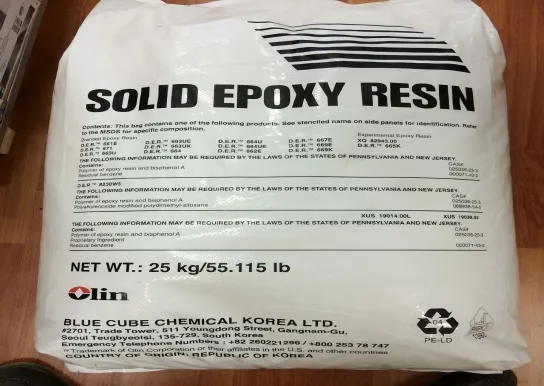
Features Of DOW DER664UE Solid Epoxy Resin
Ultra-pure formulation with minimal impurities
Exceptionally low viscosity for improved processing
Excellent wetting and leveling characteristics
Superior chemical and solvent resistance
Typical Applications Of DOW DER664UE Solid Epoxy Resin
High-performance industrial coatings
Aerospace composite matrices
Automotive OEM primer systems
Electronic encapsulation materials
Chemical-resistant tank linings
Specifications Of DOW DER664UE Solid Epoxy Resin
| Epoxy Equivalent Weight | g/eq | 650-700 |
| Viscosity at 25°C | cP | 8,000-12,000 |
| Melting Point | °C | 60-70 |
| Gardner Color | - | ≤1 |
| Hydrolyzable Chloride | ppm | ≤300 |
| Softening Point | °C | 65-75 |
| Density at 25°C | g/cm³ | 1.15-1.17 |
| Flash Point | °C | >200 |
DOW DER664UE Solid Epoxy Resin – Frequently Asked Questions (FAQ)
Q1: What is the primary functional role of DOW DER664UE in epoxy formulations?
A: DOW DER664UE is a solid bisphenol-A based epoxy resin designed primarily as a reactive binder and matrix former. It provides structural integrity, thermal stability, and chemical resistance when cured with appropriate hardeners—commonly used in powder coatings, electrical encapsulants, and high-performance composites.
Q2: How does DOW DER664UE differ from liquid epoxy resins like DER331 or DER332?
A: Unlike liquid counterparts, DER664UE is supplied as a free-flowing solid flake or pellet, offering improved handling safety, reduced volatility, and enhanced storage stability. Its solid form supports solvent-free processing—particularly advantageous in powder coating and hot-melt applications where low VOC emissions and precise metering are required.
Q3: Which types of curing agents are typically compatible with DOW DER664UE?
A: DER664UE exhibits good reactivity with a range of amine-based hardeners (e.g., dicyandiamide, aromatic amines, and latent amine adducts), anhydrides, and phenolic resins. Selection depends on the desired cure profile—ambient, thermal, or UV-assisted—and final performance requirements such as glass transition temperature or flexibility.
Q4: Is DOW DER664UE suitable for food-contact or potable water applications?
A: DER664UE is not pre-qualified for direct food-contact or potable water use. Formulators intending such applications must conduct full regulatory evaluation—including migration testing and compliance verification—based on the final cured system, intended exposure conditions, and applicable regional regulations.
Q5: What are key storage and handling recommendations for DOW DER664UE?
A: Store in original sealed packaging at temperatures below 30°C in a dry, well-ventilated area. Avoid prolonged exposure to humidity and elevated temperatures, which may cause agglomeration or partial surface tack. Handle using standard industrial hygiene practices—gloves and eye protection are recommended during manual transfer or milling operations.
 English
 Español
 tiếng việt
 русский