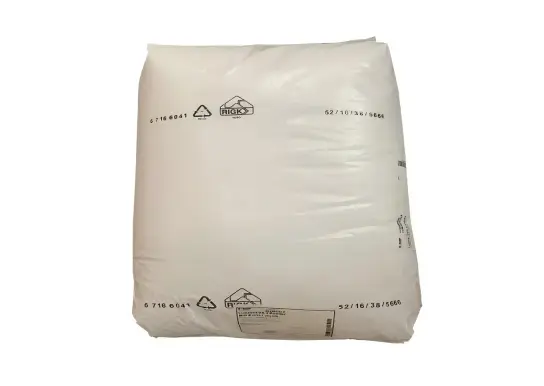
Features Of BASF Wax powder
Enhanced Lubrication Performance Significantly reduces friction during plastic processing, improving production efficiency while delivering superior surface finish and mold release properties.
Optimized Dispersion Capability Promotes even pigment distribution in masterbatch formulations, ensuring consistent color strength, uniformity, and reduced agglomeration.
High Chemical Resistance Maintains stability when exposed to various chemical environments, ensuring long-term performance without degradation.
Improved Melt Flow Efficiency Low viscosity at processing temperatures enhances material flow, reducing energy consumption and minimizing equipment wear.
Sustainable & Eco-Friendly Complies with environmental regulations due to minimal VOC emissions, supporting greener manufacturing processes.
Typical Applications of BASF Wax powder
Crayons & Art SuppliesEnhances color vibrancy and writing smoothness while acting as a key lubricant and dispersant in wax-based formulations.
Mold Release AgentsPrevents sticking in injection molding and extrusion processes, improving demolding efficiency and surface quality of finished products.
Masterbatch & Color ConcentratesEnsures uniform pigment dispersion in polymer matrices, resulting in brighter, more consistent coloration with minimal processing issues.
Plastics Processing (PVC, PE, etc.)Functions as an effective internal/external lubricant, improving processing speed, reducing defects, and enhancing final product quality.
Specifications Of BASF Wax powder
| Model Number | Appearance | Average Particle Size | Melting Point | Drop Point | Density (23℃) |
| Luwax OA3 | White Powder | / | 126-133 ℃ | / | 0.99 g/cm³ |
| Luwax AL3 | White Powder | ≤7.0 μm | 105-125℃ | / | 0.915-0.925 g/cm³ |
| Luwax AH6 | White Powder | ≤7.0 μm | 105-125℃ | / | 0.915-0.925 g/cm³ |
| Luwax AH1 | White Powder | / | 105-125℃ | / | 0.915-0.925 g/cm³ |
| Luwax OA5 | White Powder | ≤7.0 μm | 102-110℃ | / | 0.99 g/cm³ |
| Luwax AF31 | White Powder | ≤7.0 μm | 110-118℃ | 112-116℃ | 0.940-0.955 g/cm³ |
| Luwax AF30 | White Powder | <8.5 μm | 110-118℃ | 112-116℃ | 0.940-0.955 g/cm³ |
| Luwax AF29 | White Powder | ≤6.0 μm | 110-118℃ | 112-116℃ | 0.940-0.955 g/cm³ |
| Luwax OA6 | White Powder | / | / | 126-133 ℃ | 0.99 g/cm³ |
| Luwax OA2 | White Powder | / | / | 103-112 ℃ | 0.96 g/cm³ |
BASF Wax powder – Frequently Asked Questions (FAQ)
Q1: What are the primary functional benefits of BASF Wax powder in coatings and inks?
A: BASF Wax powder imparts excellent matting, slip enhancement, and surface protection. It improves scratch resistance, reduces coefficient of friction, and contributes to uniform film formation without significantly affecting transparency or color strength.
Q2: How is BASF Wax powder typically incorporated into formulations?
A: It is commonly added during the grinding or let-down stage using high-shear dispersion equipment. Pre-dispersion in a compatible solvent or resin solution is recommended for optimal distribution, especially in solvent-borne and high-solids systems.
Q3: Is BASF Wax powder suitable for water-based systems?
A: Yes — many grades are specifically engineered for compatibility with aqueous dispersions and emulsions. Performance depends on proper selection of the wax type and careful formulation to ensure stable dispersion and avoid agglomeration.
Q4: Does BASF Wax powder affect curing behavior or crosslinking efficiency?
A: Generally, it does not interfere with common curing mechanisms such as thermal, UV, or catalyzed reactions. However, due to its surface-active nature, dosage and dispersion quality should be optimized to prevent potential inhibition at very high loadings or in sensitive chemistries.
Q5: Can BASF Wax powder be used in food-contact compliant coatings?
A: Certain grades are designed and tested for compliance with general food-contact regulations where permitted by local authorities. Final regulatory suitability must be confirmed based on the specific application, substrate, and end-use conditions — consult BASF’s technical documentation and regulatory support team for appropriate grade selection.
 English
 Español
 tiếng việt
 русский