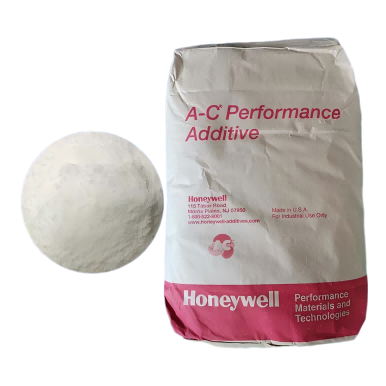
Features Of Honeywell Polyethylene Homopolymer Wax Powder ACumist B-6
High-Efficiency Lubrication: Reduces friction by 30% in PP/PE processing without affecting Vicat softening points
Thermal Stability: Maintains performance at 126°C, delaying heat accumulation in high-speed extrusion
Electrical Insulation: Improves dielectric properties for resin wires/cables (tested per IEC standards)
Surface Enhancement: Preserves gloss (>85 GU) and reduces defects in blown films
Broad Compatibility: Effective in PVC, PO, and engineering plastics
Typical Applications Of Honeywell Polyethylene Homopolymer Wax Powder ACumist B-6
Extrusion: Boosts output in pipe/profile production
Injection Molding: Enhances mold release and cycle efficiency
Film Blowing: Reduces bubble instability in LDPE/HDPE films .
Cable Insulation: Optimizes electrical resistance in resin-based wires
Specifications Of Honeywell Polyethylene Homopolymer Wax Powder ACumist B-6
Chemical Type | Polyethylene Homopolymer Wax |
Appearance | Micronized Powder |
Brand | Honeywell |
Model | ACumist B-6 |
Density | 0.93 g/cm³ |
Melting Point | Approx. 110℃ |
Viscosity (140℃) | 400 cps |
Acid Value | None |
Packaging | 20kg/bag |
Origin | USA |
Honeywell Polyethylene Homopolymer Wax Powder ACumist B-6 – Frequently Asked Questions (FAQ)
Q1: What is the primary function of ACumist B-6 in coating and ink formulations?
A: ACumist B-6 functions primarily as a matting agent and surface modifier, providing controlled gloss reduction, improved scratch resistance, and enhanced slip characteristics without significantly affecting film clarity or adhesion.
Q2: Is ACumist B-6 compatible with water-based systems?
A: Yes, ACumist B-6 is widely used in both solvent-based and water-based coatings, inks, and adhesives. Its hydrophobic polyethylene nature requires proper dispersion—typically via high-shear mixing or pre-dispersion in a carrier—but it remains stable and effective in aqueous environments once fully incorporated.
Q3: How does ACumist B-6 differ from copolymer wax additives?
A: As a homopolymer polyethylene wax, ACumist B-6 offers higher crystallinity and melting point consistency compared to ethylene-acrylic acid or ethylene-vinyl acetate copolymers, resulting in more predictable migration behavior, superior thermal stability, and sharper melt characteristics during processing.
Q4: What is the recommended method for incorporating ACumist B-6 into thermoplastic polymer melts?
A: For thermoplastic compounding, ACumist B-6 is typically added during the final extrusion or melt-blending stage. Pre-blending with a portion of the base resin or using masterbatch dilution helps ensure uniform distribution and minimizes agglomeration due to its fine particle size and low bulk density.
 English
 Español
 tiếng việt
 русский