English
 Español
 tiếng việt
 русский
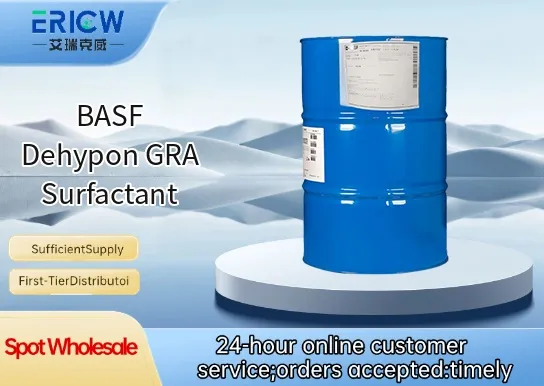
Nonionic surfactant based on glycerol monoalkyl ethers, offering excellent compatibility with anionic and cationic systems.
Low foaming profile ideal for high-shear industrial cleaning and metalworking applications.
High hydrolytic stability across a broad pH range (pH 4–12), ensuring consistent performance in demanding formulations.
EcoVadis-recognized sustainable profile with readily biodegradable components and low aquatic toxicity.
Effective grease and oil emulsification at low use levels, contributing to formulation efficiency and cost optimization.
Industrial & institutional (I&I) hard-surface cleaners, including floor, glass, and stainless-steel cleaners.
Metal cleaning and degreasing formulations for automotive and aerospace pre-treatment lines.
Emulsion polymerization aids in acrylic and styrene-butadiene latex production.
Agrochemical adjuvants for improving active ingredient dispersion and foliar retention.
Textile auxiliary systems, such as scouring and dyeing assistants for polyester-cotton blends.
| Chemical Type | Glycerol monoalkyl ether nonionic surfactant |
| Product Form | Clear to slightly hazy liquid |
| Appearance | Pale yellow to colorless, homogeneous liquid |
| pH (1% aqueous solution) | 6.0 – 8.0 |
| Solubility | Freely soluble in water and common organic solvents (e.g., ethanol, ethyl acetate) |
| Cloud Point (1% aqueous solution) | ≥ 95 °C |
| Primary Applications | Industrial cleaning, metalworking fluids, agrochemicals, textile auxiliaries, emulsion polymerization |
| Key Features | Low foaming, high electrolyte tolerance, low skin irritation potential, non-corrosive to metals |
Q1: What is the primary chemical nature of Dehypon GRA?
A: Dehypon GRA is a nonionic surfactant based on alkyl glyceryl ether chemistry, offering excellent wetting, emulsification, and solubilization properties with low foaming and good compatibility across a broad pH range.
Q2: In which types of industrial cleaning formulations is Dehypon GRA most commonly applied?
A: It is widely used in high-performance aqueous industrial cleaners—especially for metal parts, precision optics, and electronics—where low residue, high soil removal efficiency, and compatibility with sensitive substrates are critical.
Q3: How does Dehypon GRA perform in hard water conditions?
A: Dehypon GRA demonstrates good stability and performance in moderately hard water due to its nonionic character and ether-based structure, minimizing precipitation or efficacy loss compared to many anionic surfactants.
Q4: Is Dehypon GRA suitable for use in rinse-free or low-rinse cleaning processes?
A: Yes, its low foaming behavior, high rinsability, and minimal residue formation make it well-suited for low-rinse and no-rinse applications, particularly where water conservation or process efficiency is prioritized.
Q5: What are key handling and storage recommendations for Dehypon GRA?
A: Store in original sealed containers at temperatures between 5 °C and 30 °C, away from direct sunlight and strong oxidizing agents. Ensure adequate ventilation during handling, and refer to the Safety Data Sheet for occupational hygiene guidance.
Contact With Us:
E-mail: wangxingqiang@ericwchem.com
Have a Questions? Call Us:
Add:
Building A1, Jiete Industrial Park, Huangpu District, Guangzhou City, Guangdong Province, China