English
 Español
 tiếng việt
 русский
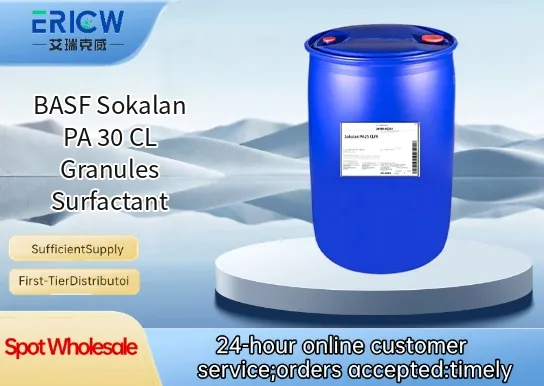
Highly effective polyacrylate-based dispersant for inorganic pigments and fillers.
Free-flowing granular form ensures excellent dosing accuracy and dust-free handling.
Enhances colloidal stability and rheology control in aqueous systems without foaming.
Compatible with a broad pH range (pH 4–10) and stable under moderate shear conditions.
Low VOC and APEO-free formulation supporting sustainable industrial formulations.
Architectural and industrial waterborne paints and coatings.
Construction chemicals including cementitious tile adhesives and self-leveling compounds.
Inkjet ink formulations requiring pigment stabilization and jetting reliability.
Mineral slurries and ceramic glaze suspensions for spray-drying processes.
Agrochemical suspension concentrates (SC) and seed treatment formulations.
| Chemical Type | Polyacrylic acid, sodium salt (partially neutralized) |
| Product Form | Free-flowing granules |
| Appearance | White to off-white granules |
| pH (1% aqueous solution) | 6.5 – 8.5 |
| Solubility | Freely soluble in cold and warm water |
| Primary Applications | Pigment dispersion, rheology modifier, stabilizer for mineral suspensions |
| Key Features | Dust-free handling, high electrolyte tolerance, low foaming |
| Benefits | Improved storage stability, enhanced color development, reduced settling |
Q1: What is the primary function of Sokalan PA 30 CL in industrial formulations?
A: Sokalan PA 30 CL is an anionic polyacrylate-based dispersant and rheology modifier, primarily used to stabilize pigment suspensions, prevent agglomeration, and control viscosity in aqueous systems such as coatings, construction mortars, and ceramic tile adhesives.
Q2: How does the granular form benefit handling and formulation compared to liquid alternatives?
A: The free-flowing granular format offers improved dust control during dosing, enhanced storage stability, and easier integration into dry-mix applications—especially where precise metering and compatibility with other solid additives are critical.
Q3: Is Sokalan PA 30 CL compatible with common cementitious or gypsum-based systems?
A: Yes, it demonstrates good compatibility with Portland cement, calcium sulfate hemihydrate (gypsum), and blended binder systems, supporting stable dispersion without compromising setting behavior or early strength development when used within recommended dosage ranges.
Q4: What is the typical dosage range for effective performance in aqueous dispersions?
A: Effective dosage generally ranges from 0.1% to 2% by weight relative to the total solids content, depending on pigment type, particle size distribution, and desired rheological profile—formulators are advised to conduct application-specific optimization trials.
Contact With Us:
E-mail: wangxingqiang@ericwchem.com
Have a Questions? Call Us:
Add:
Building A1, Jiete Industrial Park, Huangpu District, Guangzhou City, Guangdong Province, China