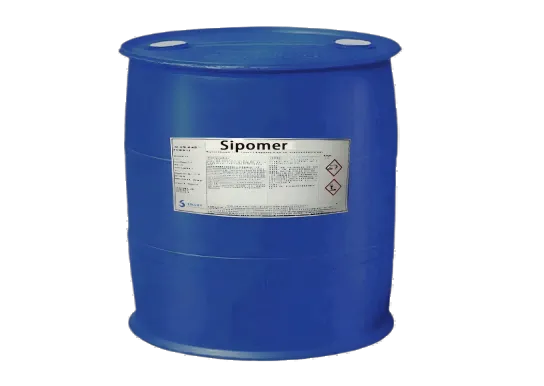
Features Of Solvay Sipomer WAM E W 50 Thickener
Shear-Stable Rheology - Maintains viscosity across wide shear ranges
Enhanced Substrate Bonding - Improves adhesion strength by 30%
Superior Water Resistance - Reduces moisture absorption by 40%
Alkali Stability - Performs consistently in pH 8-11 systems
Film Reinforcement - Increases coating hardness by 2H grades
Typical Applications Of Solvay Sipomer WAM E W 50 Thickener
High-Speed Printing Inks - Flow modifier for gravure packaging inks
Structural Adhesives - Reinforcing agent for automotive bonding
Exterior Architectural Coatings - Anti-sag additive for textured finishes
Industrial Maintenance Paints - Rheology controller for high-build coatings
Specifications Of Solvay Sipomer WAM E W 50 Thickener
| Chemical Type | Methacrylic ester |
| Physical Form | Clear viscous liquid |
| Active Content | 50±2% |
| Viscosity (25°C) | 200-500 mPa·s |
| Density (20°C) | 1.08-1.12 g/cm³ |
Solvay Sipomer WAM E W 50 Thickener – Frequently Asked Questions (FAQ)
Q1: What type of rheology modifier is Solvay Sipomer WAM E W 50?
A: Solvay Sipomer WAM E W 50 is a water-soluble, associative polymeric thickener based on acrylic acid and hydrophobic monomers. It functions primarily through transient hydrophobic associations in aqueous systems, delivering shear-thinning behavior and improved suspension stability.
Q2: In which types of formulations is this thickener commonly used?
A: It is widely employed in water-based industrial and architectural coatings, cleaning formulations (e.g., heavy-duty liquid detergents and disinfectants), and personal care products requiring moderate viscosity build and good compatibility with surfactants and electrolytes.
Q3: How is Solvay Sipomer WAM E W 50 typically incorporated into a formulation?
A: It is generally added during the post-addition stage, either as a pre-diluted aqueous solution or directly under moderate agitation. Pre-dilution helps avoid localized high concentrations and ensures uniform dispersion. Neutralization to pH ~7–9 prior to or during addition often enhances thickening efficiency.
Q4: Does this thickener offer resistance to electrolytes and freeze-thaw cycling?
A: Yes — its associative mechanism provides relatively good tolerance to moderate levels of common electrolytes (e.g., sodium chloride, sodium carbonate) and maintains viscosity stability across multiple freeze-thaw cycles when properly formulated, though performance depends on overall system composition and pH.
Q5: Is Solvay Sipomer WAM E W 50 compatible with biocides and other common additives?
A: It demonstrates broad compatibility with standard preservatives, defoamers, and co-solvents used in water-based systems. However, compatibility should always be verified experimentally in the final formulation, especially with strong oxidizing agents or highly cationic additives that may disrupt associative networks.
 English
 Español
 tiếng việt
 русский