English
 Español
 tiếng việt
 русский
Description
Rhodoline 4188, a wetting and dispersing agent by Solvay Rhodia, excels in effectively wetting surfaces of both organic and inorganic pigments, significantly cutting down grinding and dispersion time.
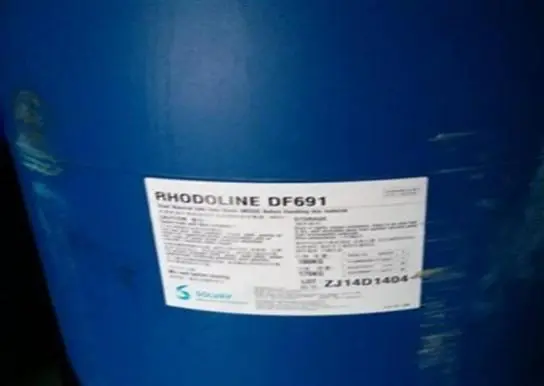
Brand: Solvay
Model: Rhodoline 4188
Application: Effectively wets the surfaces of various organic/inorganic pigments
Applications of Rhodoline 4188
Dispersion of organic and inorganic pigments
Q1: What is Rhodoline 4188 primarily used for?
A: Rhodoline 4188 is a high-performance, non-ionic surfactant designed to enhance wetting, dispersion, and stabilization in aqueous industrial formulations—particularly in pigment-based systems such as architectural coatings, industrial paints, and inkjet inks.
Q2: Is Rhodoline 4188 compatible with common pigment types?
A: Yes, it demonstrates broad compatibility with organic pigments, carbon black, and many inorganic pigments. Its balanced HLB and molecular architecture support effective adsorption and steric stabilization across diverse pigment surfaces.
Q3: How does Rhodoline 4188 perform under high-shear or elevated temperature conditions?
A: It maintains excellent colloidal stability and surface activity during high-shear mixing and shows good thermal resilience in typical processing environments, supporting robust formulation integrity without premature degradation or phase separation.
Q4: Can Rhodoline 4188 be used in low-VOC or waterborne systems?
A: Yes—it is well-suited for low-VOC and waterborne applications due to its non-ionic nature, low foaming tendency, and absence of volatile organic co-solvents or alkylphenol ethoxylates.
Q5: What is the recommended dosage range for Rhodoline 4188 in pigment dispersions?
A: Dosage depends on pigment type, loading, and desired performance; it is typically used at low concentrations, generally ranging from 0.1% to 2% by weight relative to pigment solids.
Contact With Us:
E-mail: wangxingqiang@ericwchem.com
Have a Questions? Call Us:
Add:
Building A1, Jiete Industrial Park, Huangpu District, Guangzhou City, Guangdong Province, China