English
 Español
 tiếng việt
 русский
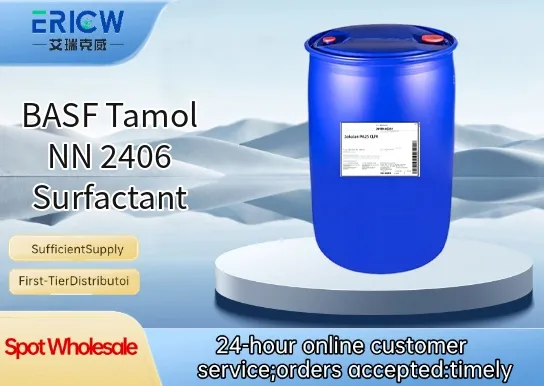
High-performance anionic dispersant based on sodium naphthalene formaldehyde condensate (NFC).
Excellent colloidal stabilization for inorganic pigments and fillers in aqueous systems.
Low foaming profile suitable for high-shear industrial processes.
Good compatibility with a broad range of water-based resins and additives.
Enhanced wetting and rheology control without compromising storage stability.
Cementitious systems, including concrete admixtures and grouts.
Waterborne architectural and industrial coatings.
Inorganic pigment dispersions for colorants and inkjet inks.
Ceramic tile adhesives and self-leveling compounds.
Mineral processing slurries and functional suspensions.
| Chemical Type | Sodium naphthalene formaldehyde condensate (NFC) |
| Product Form | Aqueous solution (~40% active content) |
| Appearance | Brownish viscous liquid |
| pH (1% aqueous solution) | 7.5 – 9.5 |
| Density (20°C) | 1.18 – 1.22 g/cm³ |
| Solubility | Completely miscible in water |
| Primary Applications | Dispersant for cement, pigments, and mineral fillers |
| Key Features | High dispersion efficiency, low foam, shear-stable |
Q1: What is the primary function of Tamol NN 2406 in industrial formulations?
A: Tamol NN 2406 is a sodium naphthalene formaldehyde condensate surfactant designed primarily as a dispersing agent and wetting aid. It helps stabilize pigment and filler particles in aqueous systems by providing electrostatic repulsion and steric hindrance, thereby improving suspension stability, reducing viscosity, and enhancing uniformity in final products.
Q2: In which types of industrial applications is Tamol NN 2406 most commonly used?
A: This surfactant is widely employed in water-based coatings, construction chemicals (e.g., cement admixtures and tile adhesives), agrochemical suspensions (SC formulations), and ceramic tile adhesives—where effective particle dispersion and rheology control in high-ionic-strength environments are critical.
Q3: Is Tamol NN 2406 compatible with other common additives such as defoamers or thickeners?
A: Yes, Tamol NN 2406 generally exhibits good compatibility with non-ionic thickeners (e.g., HEC, HPMC) and silicone- or mineral oil–based defoamers. However, compatibility should be verified experimentally in each specific formulation due to potential interactions with cationic species or highly associative thickeners.
Q4: How should Tamol NN 2406 be incorporated into a formulation for optimal performance?
A: It is typically added during the pigment/premix stage under moderate shear to ensure thorough wetting and dispersion. Dosage depends on formulation requirements but generally ranges from 0.1% to 2% by weight relative to solid content. Pre-dilution in water may improve handling and uniform distribution.
Contact With Us:
E-mail: wangxingqiang@ericwchem.com
Have a Questions? Call Us:
Add:
Building A1, Jiete Industrial Park, Huangpu District, Guangzhou City, Guangdong Province, China