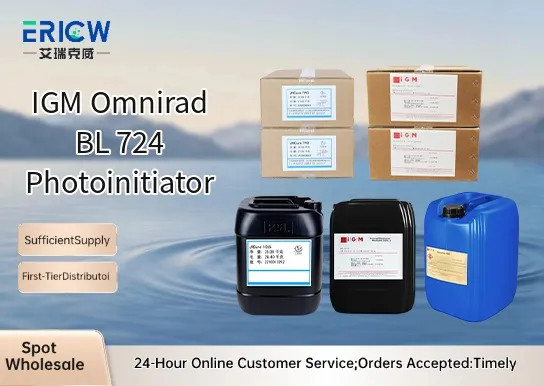
IGM Omnirad 4MBZ flakes is a high-efficiency benzophenone Type II free radical UV photoinitiator in the Omnirad series, designed for UV radiation curing systems. In the form of flake solid, it needs to be used synergistically with tertiary amine synergists. When exposed to UV light, it can efficiently initiate the free radical polymerization of acrylates and other unsaturated oligomers. Benzene-free, low-odor and highly compatible, it is suitable for various UV curing formulations

Benzophenone Type II initiation - Synergizes with tertiary amine synergists, high free radical initiation efficiency and stable polymerization reaction
Flake solid form - Flake structure easy to weigh and dissolve, convenient storage and transportation, accurate and controllable addition
Benzene-free low-odor environmental protection - Benzene-free formula, extremely low odor, meets high-end environmental compliance, suitable for sensitive scenarios
Multi-system compatibility - Compatible with various acrylate systems, suitable for solvent-based and water-based UV curing formulations, strong versatility
Wide adaptability - Suitable for colored and transparent systems, no impact on the appearance and performance of end products
Printing ink field - Offset, screen, flexo inks and overprint varnishes, fast curing, high printing precision
Wood coating field - Wood UV varnishes/colored paints, strong adhesion, scratch resistance, improving wood decoration durability
Plastic coating field - UV protective coatings for plastic surfaces, good fit, excellent weather resistance and chemical resistance
Paper coating field - Paper UV curing coatings, high efficiency curing, improving paper surface gloss and wear resistance
UV adhesive field - Acrylate-based UV adhesives, high bonding strength, fast curing speed, suitable for general bonding
| Brand | IGM (Omnirad series) |
| Chemical Type | Benzophenone Type II free radical UV photoinitiator |
| Chemical Composition | 4-Methylbenzophenone |
| Alias | 4-Methylbenzophenone, p-Methylbenzophenone |
| CAS No | 134-84-9 |
| Appearance (25℃) | White to off-white flake solid |
| Purity | ≥98.5% |
| Molecular Weight | 196.25g/mol |
| Melting Point | 56-60℃ |
| Absorption Wavelength Range | 250-350nm (in methanol) |
Q1: What is the primary photoreactivity mechanism of Omnirad 4MBZ?
A: Omnirad 4MBZ is a Type II photoinitiator that functions via hydrogen abstraction—typically from amine or ether co-initiators—generating reactive radicals under UV-A to UV-C irradiation. It exhibits strong absorption in the near-UV range and is especially effective in systems where low yellowing and good surface cure are required.
Q2: How does the flake form benefit formulation and processing?
A: The flake morphology improves handling safety compared to fine powders, reduces dust generation during dosing, enhances flowability in automated feeding systems, and supports more uniform dispersion in viscous resins—especially in high-solids or solvent-free UV-curable coatings and inks.
Q3: Is Omnirad 4MBZ suitable for food-contact or medical-grade UV formulations?
A: While Omnirad 4MBZ is not inherently restricted for such applications, its suitability depends on full regulatory assessment of the final cured system—including migration behavior, extractables profile, and compliance with applicable regional frameworks. Formulators must conduct end-product testing and consult current regulatory guidance before use in sensitive applications.
Q4: What are typical compatibility considerations when blending Omnirad 4MBZ with other photoinitiators?
A: Omnirad 4MBZ is commonly used synergistically with Type I initiators (e.g., acylphosphine oxides) to broaden spectral response and improve through-cure. However, caution is advised when combining with highly reactive benzophenone derivatives or thiol-based systems, as competitive quenching or premature radical termination may occur—compatibility should be verified experimentally per formulation.
Q5: How should Omnirad 4MBZ flakes be stored to maintain performance stability?
A: Store in original sealed packaging at cool, dry conditions (preferably below 25 °C), protected from light and moisture. Prolonged exposure to ambient humidity or UV light may lead to surface degradation or reduced initiation efficiency—therefore, minimize container opening time and reseal tightly after each use.
Contact With Us:
E-mail: wangxingqiang@ericwchem.com
Have a Questions? Call Us:
Add:
Building A1, Jiete Industrial Park, Huangpu District, Guangzhou City, Guangdong Province, China
 English
 Español
 tiếng việt
 русский