Description
Alkyl ester twelve: A high-performance solvent used in paints, inks, and cleaning agents.
CAS No.
CAS No. 25265-77-4
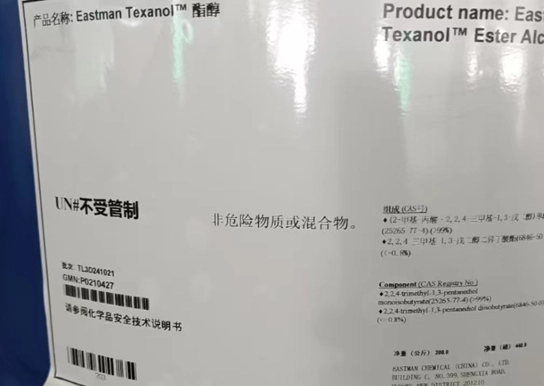
Eastman Texanol™ ester alcohol is the premier coalesce nt for latex paints. It performs well in all types of latex paints, in a variety of weather conditions, and over substrates with different levels of porosity. Eastman Texanol™ ester alcohol provides the highest level of film integrity at low levels of coalescent, enhancing the performance properties of the paint including low temperature coalescence, touch-up, scrub resistance, washability, color development, thermal flexibility, and resistance to mudcracking. Eastman Texanol™; ester alcohol also enhances thickening efficiency when used with associative thickeners.
Eastman Texanol™ ester alcohol also works well in a variety of other applications. It is an ideal choice as a retarder solvent for use in coil coatings and high-bake enamels. Its unique balance of properties also makes it useful for a variety of chemical specialty applications such as ore flotation/frothing, oil-drilling muds, wood preservative carriers, and floor polishes.
With a boiling point of 254°C, (vapor pressure 0.01 kPa @ 20°C), Eastman Texano l ester alcohol is not classified as a VOC according to European Union Deco paint Directive 2004/42/EC (commonly referred to as the Deco paint Directive); European Union Solvent Emissions Directive); and the China State Environmental Protection agency. Due to its non-VOC status, low toxicity, and biodegradability, Eastman Texanol™ ester alcohol has been awarded Green Label Type II certificate in China by the China Environmental United Certification Co . Ltd. (CEC), a wholly-owned subsidiary of the State Environmental Protection Administration of China (SEPA). The chemical substances for this product are listed as Inert Ingredients Permitted for Use in
Nonfood Use Pesticide Products under the Federal Insecticide, Fungicide, and Rodenticide Act (FIFRA). For details on specific permissions, click here.
| Property | Typical Value, Units |
| Acidity as Acetic Acid | 0.05 wt % max. |
| Assay | 98.5 wt % min. |
| Autoignition Temperature | 393°C (739°F) |
| Boiling Point @ 760 mm Hg | 254°C (489.2°F) |
| Color Pt-Co | 10 max. |
| Critical Pressure | 19.9 ATM |
| Critical Temperature | 391.9°C |
| Critical Volume | 718.6 ml/g·mol |
| Electrical Resistance | >20 Megohms |
| Empirical Formula | C12H24O3 |
| Evaporation Rate | 0.002 6051 |
| (n-butyl acetate = 1) (ether = 1) | |
| Expansion Coefficient, per °C @ 20°C | 0.001 |
| Flash Point Cleveland Open Cup | 120°C (248°F) |
| Freezing Point | -50°C (-58°F) |
| Hansen Solubility Parameters | 7.4 3 |
| Nonpolar Polar | 4.8 9.3 |
| Hydrogen Bonding Total | |
| Heat of Combustion | -1607.7 kcal/g·mol |
| Heat of Vaporization | 15196 cal/g·mol |
| Liquid Heat Capacity @ 25°C | 110.74 cal/(g*mol)(°C) |
| Liquid Viscosity @ 20°C | 13.5 cP (mPa·s) |
| Molecular Weight | 216.3 |
| Nitrocellulose Solubility | Active |
| Refractive Index @ 20°C | 1.4423 |
| Solubility | 0.1% 3.0% |
| in Water, @ 20°C Water in, @ 20°C | |
| Specific Gravity @ 20°C/20°C | 0.95 |
| Surface Tension @ 20°C | 28.9 dynes/cm |
| Vapor Density (air = 1) | 7.5 |
| Vapor Pressure @ 20°C | 0.0013 kPa (0.01 mm Hg |
| @ 25°C | 0.00173 kPa |
| @ 55°C | 0.033 kPa |
| Wt/Vol @ 20°C | 0.95 kg/L (7.9 lb/gal) |
Properties reported here are typical of average lots . Eastman makes no representation that the material in any particular shipment will conform exactly to the values given.
Q1: What is the primary function of 2,2,4 Trimethyl 1,3 Pentanediol Monoisobutyrate in coating and ink formulations?
A: It functions primarily as a reactive diluent and coalescing aid, improving film formation, flow, and leveling while reducing VOC content without significantly compromising cure speed or final film properties.
Q2: Is this material compatible with common resin systems used in industrial coatings?
A: Yes, it demonstrates good compatibility with acrylics, polyesters, alkyds, and epoxy-based systems, and is frequently selected for its ability to enhance solubility and reduce viscosity without phase separation under typical processing conditions.
Q3: How does its reactivity compare to conventional glycol ether esters?
A: Unlike many glycol ether esters, it contains a secondary hydroxyl group that can participate in crosslinking reactions—offering potential for improved film hardness and chemical resistance when used with suitable curing agents.
Q4: What are typical handling and storage recommendations?
A: Store in tightly sealed containers under cool, dry, well-ventilated conditions away from strong oxidizers and direct sunlight. It is stable under recommended storage conditions but should be protected from prolonged exposure to moisture and elevated temperatures to maintain performance consistency.
Contact With Us:
E-mail: wangxingqiang@ericwchem.com
Have a Questions? Call Us:
Add:
Building A1, Jiete Industrial Park, Huangpu District, Guangzhou City, Guangdong Province, China
 English
 Español
 tiếng việt
 русский