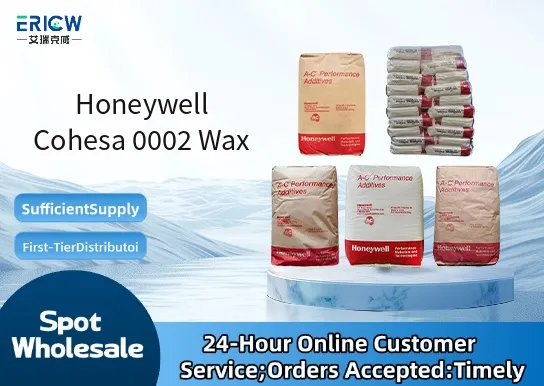
Features Of Honeywell ethylene-acrylic EAA copolymer wax powder A-C 540A
Exceptional Adhesion: Significantly boosts hot melt adhesive bonding strength for reliable adhesion.
Polar Compatibility: Performs well in polar materials, optimizing coating adhesion performance.
Pigment Dispersion: Acts as dispersant to improve pigment uniformity in coatings.
Wear Resistance: Reduces surface scratches and extends coating lifespan via enhanced durability.
Surface Smoothness: Improves coating texture and visual appearance with better smoothness.
Multifunctional Use: Suitable for hot melt adhesives, coatings, plastic processing, and inks.
Typical Applications Of Honeywell ethylene-acrylic EAA copolymer wax powder A-C 540A
Hot Melt Adhesives: Enhances adhesion and processing performance for industrial bonding.
Coatings: Optimizes adhesion, wear resistance, and surface smoothness of formulations.
Plastic Processing: Improves surface properties and production efficiency as additive.
Inks: Boosts print quality and abrasion resistance of ink systems.
Industrial: Versatile solutions for rubber products and textile lubricants.
Specifications Of Honeywell ethylene-acrylic EAA copolymer wax powder A-C 540A
Chemical Type | Ethylene-Acrylic Acid (EAA) Copolymer |
Appearance | Powder |
Brand | Honeywell |
Model | A-C 540A |
Acid Value | 45 mg KOH/g |
Melting Point | Approx. 98℃ |
Density | 0.93 g/cm³ |
Packaging | 20kg/bag |
Origin | USA |
Honeywell ethylene-acrylic EAA copolymer wax powder A-C 540A – Frequently Asked Questions (FAQ)
Q1: What is the primary functional role of A-C 540A in polymer and coating formulations?
A: A-C 540A functions primarily as a processing aid and surface modifier, offering controlled melt viscosity reduction, improved dispersion of pigments and fillers, enhanced slip and abrasion resistance, and reduced coefficient of friction in thermoplastic and thermoset systems.
Q2: Is A-C 540A compatible with common engineering resins such as polyolefins, polyesters, and PVC?
A: Yes — due to its ethylene-acrylic acid backbone and tailored polarity, A-C 540A exhibits good compatibility with polyolefins (e.g., PP, HDPE), polyesters (PET, PBT), and rigid or plasticized PVC, supporting uniform dispersion without phase separation under typical processing conditions.
Q3: How does A-C 540A differ from traditional polyethylene waxes in terms of thermal stability and polarity?
A: Unlike non-polar PE waxes, A-C 540A contains acrylic acid comonomer units that introduce moderate polarity and hydrogen-bonding capability, resulting in improved adhesion to polar substrates and broader thermal processing windows — typically stable up to standard extrusion and injection molding temperatures without significant degradation.
Q4: What is the recommended method for incorporating A-C 540A into solid polymer blends?
A: A-C 540A is most effectively incorporated via dry blending with base resin prior to extrusion or compounding. It may also be added directly to molten polymer streams using side-feeders; pre-blending ensures uniform distribution and minimizes agglomeration during high-shear processing.
Q5: Can A-C 540A be used in applications requiring FDA compliance for indirect food contact?
A: A-C 540A is manufactured using raw materials and processes consistent with FDA 21 CFR §178.3750 (waxes for food packaging), and it is commonly selected for indirect food-contact applications such as packaging film additives and container coatings — however, final regulatory approval depends on the complete formulation, processing conditions, and end-use requirements.
 English
 Español
 tiếng việt
 русский