English
 Español
 tiếng việt
 русский
Excellent abrasion resistance for extended service life in demanding mechanical environments.
High elasticity and recovery performance, maintaining shape integrity after repeated deformation.
Good processability via injection molding and extrusion, supporting high-volume manufacturing.
Outstanding low-temperature flexibility down to –40 °C without significant stiffening.
Hydrolysis-resistant formulation suitable for humid or wet-condition applications.
Automotive interior trim components including instrument panel overlays and gear shift boots.
Industrial rollers and conveyor belts requiring wear resilience and dimensional stability.
Flexible hoses and tubing for pneumatic and fluid transfer systems.
Consumer electronics protective casings and soft-touch overmolded grips.
Footwear midsoles and outsoles where dynamic cushioning and energy return are critical.
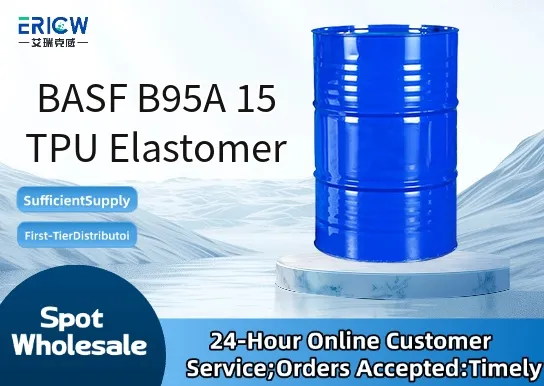
| Chemical Type | Thermoplastic Polyurethane (TPU), polyester-based |
| Product Form | Pellets |
| Appearance | Off-white to light beige, free-flowing granules |
| Density (ISO 1183) | 1.18–1.20 g/cm³ |
| Melt Flow Index (ISO 1133, 220 °C/10 kg) | 15 g/10 min |
| Hardness (Shore A, ISO 7619-1) | 95 ± 2 |
| Ultimate Tensile Strength (ISO 527-2) | 35–42 MPa |
| Elongation at Break (ISO 527-2) | 450–550 % |
Q1: What is the primary application domain for BASF B95A 15 TPU Elastomer?
A: BASF B95A 15 is a thermoplastic polyurethane elastomer specifically engineered for demanding extrusion and injection molding applications, including flexible tubing, technical profiles, and wear-resistant components in automotive, industrial, and medical device assemblies where high elasticity, abrasion resistance, and melt processability are required.
Q2: How does B95A 15 differ from other TPU grades in the B95 series?
A: B95A 15 is distinguished by its balanced Shore A hardness (~95A), enhanced melt stability, and optimized flow behavior for thin-wall and precision parts. Compared to softer or harder variants in the B95 family, it offers improved dimensional stability during cooling and reduced post-molding shrinkage, making it particularly suitable for tight-tolerance applications.
Q3: Is drying required before processing, and what are the recommended conditions?
A: Yes — like most hygroscopic TPUs, B95A 15 must be thoroughly dried prior to processing to prevent surface defects and molecular degradation. Standard practice is vacuum or dehumidifying drying at 80–90 °C for 2–4 hours until moisture content is below 0.02 wt%, verified by Karl Fischer titration.
Q4: Can B95A 15 be blended with other polymers, and what compatibility considerations apply?
A: B95A 15 exhibits good compatibility with certain polyesters and other TPUs of similar polarity and molecular architecture. Blending with non-polar resins such as PP or PE typically requires compatibilizers and may compromise mechanical performance; feasibility should be validated through rheological and morphological testing in the intended end-use formulation.
Contact With Us:
E-mail: wangxingqiang@ericwchem.com
Have a Questions? Call Us:
Add:
Building A1, Jiete Industrial Park, Huangpu District, Guangzhou City, Guangdong Province, China