English
 Español
 tiếng việt
 русский
Excellent elasticity and resilience for repeated compression cycling.
Good processability via injection molding and extrusion without plasticizers.
Outstanding soft-touch feel with skin-friendly surface properties.
High resistance to UV degradation and thermal aging up to 70°C continuous use.
RoHS-compliant formulation with no phthalates, heavy metals, or halogenated flame retardants.
Soft-grip overmolding for power tools and hand-held appliances.
Sealing rings and gaskets in automotive fluid systems.
Medical device components requiring biocompatibility (ISO 10993 pre-screened).
Consumer electronics casings and protective sleeves.
Flexible tubing for low-pressure pneumatic and food-grade conveying.
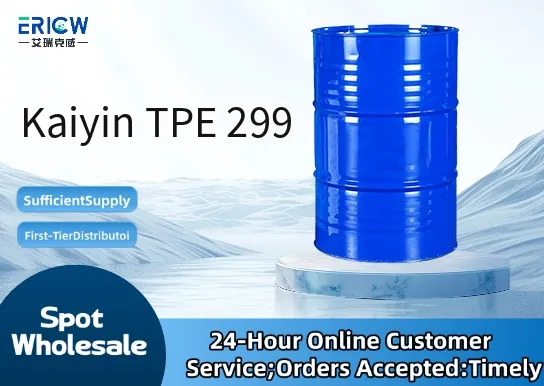
| Chemical Type | Thermoplastic Elastomer (SEBS-based) |
| Product Form | Pellets |
| Appearance | Translucent beige granules |
| Hardness (Shore A) | 85 ± 3 |
| Density (g/cm³) | 0.90 ± 0.02 |
| Melt Flow Rate (2.16 kg, 230°C) | 12–15 g/10 min |
| Tensile Strength (MPa) | 8.5–10.0 |
| Elongation at Break (%) | 450–520 |
Q1: What is the primary function of Kaiyin TPE 299 in thermoplastic elastomer formulations?
A: Kaiyin TPE 299 functions as a high-efficiency processing aid and melt flow modifier, helping to reduce viscosity, improve dispersion of fillers and pigments, and enhance surface finish in TPE compounds—particularly in SEBS- and TPO-based systems.
Q2: Is Kaiyin TPE 299 compatible with common polymer matrices used in soft-touch applications?
A: Yes—it demonstrates broad compatibility with styrenic block copolymers (e.g., SEBS, SBS), polyolefins (PP, PE), and thermoplastic polyurethanes (TPU), making it suitable for soft-touch overmolding, grips, and consumer product skins.
Q3: How should Kaiyin TPE 299 be incorporated into a compound?
A: It is typically added during the compounding stage—either pre-blended with base polymer or fed directly into the extruder—using standard melt-mixing equipment. Good dispersion is achieved under typical TPE processing conditions (160–220 °C).
Q4: Does Kaiyin TPE 299 affect the mechanical properties of the final TPE product?
A: When used within recommended dosage ranges, it maintains key performance attributes—including tensile strength, elongation, and elasticity—while improving processability. Significant over-addition may reduce hardness or modulus, so optimization is advised for each formulation.
Q5: Is Kaiyin TPE 299 suitable for applications requiring regulatory compliance for food contact or skin-safe products?
A: Kaiyin TPE 299 is designed for industrial TPE compounding and is not pre-certified for direct food contact or medical use. Customers intending such applications should conduct full regulatory evaluation—including migration testing and toxicological review—as part of their qualification process.
Contact With Us:
E-mail: wangxingqiang@ericwchem.com
Have a Questions? Call Us:
Add:
Building A1, Jiete Industrial Park, Huangpu District, Guangzhou City, Guangdong Province, China