English
 Español
 tiếng việt
 русский
Excellent abrasion resistance for demanding mechanical environments.
Outstanding elasticity and recovery performance across a wide temperature range.
Good processability in extrusion, injection molding, and blow molding operations.
High transparency and clarity suitable for aesthetic-sensitive applications.
Hydrolysis-resistant formulation enhances long-term stability in humid conditions.
Medical tubing and fluid handling components requiring biocompatibility support.
Automotive interior trim and soft-touch overlays with premium haptic feel.
Consumer electronics protective casings and wearable device bands.
Industrial hoses and pneumatic tubing subject to repeated flexing.
Footwear midsoles and outsoles requiring energy return and durability.
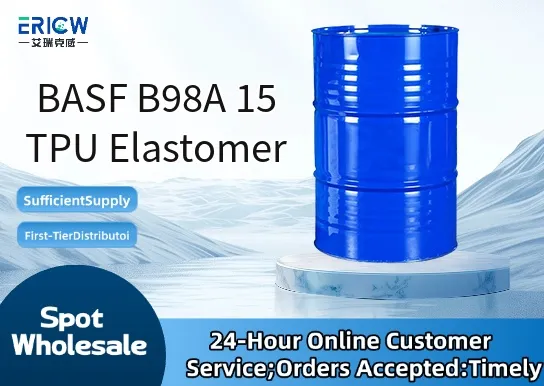
| Chemical Type | Thermoplastic Polyurethane (TPU), polyester-based |
| Product Form | Pellets |
| Appearance | Translucent, light yellow granules |
| Primary Applications | Extrusion, injection molding, blow molding |
| Key Features | Abrasion resistance, elasticity, hydrolysis resistance, transparency |
| Benefits | Reduced part wear, design flexibility, consistent surface quality, processing efficiency |
| Density (ISO 1183) | ~1.20 g/cm³ |
| Melt Flow Index (ISO 1133, 230 °C/5 kg) | 15 g/10 min |
Q1: What is the primary application domain for BASF B98A 15 TPU Elastomer?
A: BASF B98A 15 is a thermoplastic polyurethane elastomer specifically engineered for extrusion and injection molding of high-performance flexible components, commonly used in technical tubing, protective sheathing, and dynamic sealing applications where resilience, abrasion resistance, and low-temperature flexibility are critical.
Q2: How does B98A 15 compare to other TPU grades in terms of processing behavior?
A: B98A 15 exhibits excellent melt stability and low viscosity at processing temperatures, enabling smooth extrusion and efficient mold filling. Its balanced hardness and narrow molecular weight distribution support consistent dimensional control and reduced post-molding shrinkage compared to many standard aromatic TPUs.
Q3: Is B98A 15 suitable for contact with food or potable water?
A: B98A 15 is not pre-certified for food-contact or drinking water applications. Customers intending such use must conduct full regulatory evaluation—including migration testing and compliance verification—based on their specific processing conditions, end-use environment, and applicable regional requirements.
Q4: What drying conditions are recommended prior to processing?
A: To ensure optimal mechanical properties and surface quality, B98A 15 should be dried thoroughly before processing—typically at 80–90 °C for 2–4 hours using desiccant-assisted drying. Residual moisture levels should be maintained below 0.02% to prevent hydrolysis and melt instability.
Contact With Us:
E-mail: wangxingqiang@ericwchem.com
Have a Questions? Call Us:
Add:
Building A1, Jiete Industrial Park, Huangpu District, Guangzhou City, Guangdong Province, China