English
 Español
 tiếng việt
 русский
Excellent abrasion resistance for extended service life in demanding mechanical environments.
Good low-temperature flexibility down to –40 °C, maintaining toughness and elasticity.
Outstanding oil and grease resistance, suitable for automotive and industrial fluid-contact applications.
High tensile strength and elongation at break, enabling robust performance under dynamic stress.
Processable via standard thermoplastic techniques including extrusion, injection molding, and calendering.
Automotive interior trim components, such as instrument panel skins and door inserts.
Industrial hoses and tubing requiring chemical resistance and flex fatigue durability.
Footwear midsoles and outsoles where rebound resilience and wear resistance are critical.
Medical device housings and non-implantable components meeting ISO 10993-compatibility requirements.
Consumer electronics protective casings offering impact absorption and surface aesthetics.
| Chemical Type | Thermoplastic Polyurethane (TPU), polyester-based |
| Product Form | Pellets |
| Appearance | Off-white to light tan, free-flowing granules |
| Hardness (Shore D) | 55 ± 2 |
| Density (g/cm³) | 1.18–1.22 |
| Melt Flow Rate (230 °C/2.16 kg, g/10 min) | 10–14 |
| Tensile Strength (MPa) | 32–38 |
| Elongation at Break (%) | 450–520 |
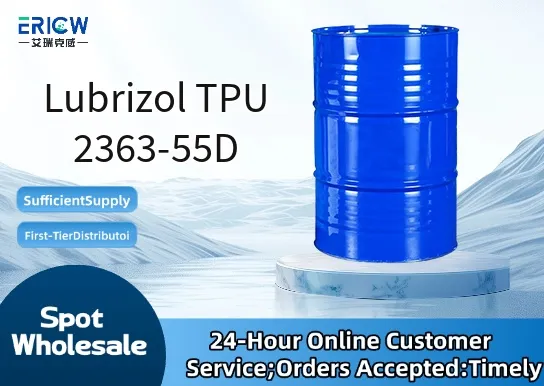
Q1: What is Lubrizol TPU 2363-55D primarily used for?
A: Lubrizol TPU 2363-55D is a thermoplastic polyurethane elastomer designed for extrusion, injection molding, and calendering applications—commonly employed in high-performance automotive interior trim, industrial hoses, wear-resistant films, and flexible consumer goods requiring excellent abrasion resistance and low-temperature flexibility.
Q2: How does TPU 2363-55D compare to other TPU grades in terms of hardness and processability?
A: With a nominal Shore D hardness of 55, TPU 2363-55D offers a balanced profile between rigidity and elasticity—softer than higher-D grades but stiffer and more dimensionally stable than many Shore A alternatives. Its melt flow characteristics support consistent processing across standard TPU equipment without requiring specialized drying or thermal profiles beyond typical TPU handling guidelines.
Q3: Is TPU 2363-55D suitable for applications requiring regulatory compliance for food contact or medical use?
A: Lubrizol TPU 2363-55D is not pre-certified for food-contact or medical device applications. While it meets general polymer safety expectations for industrial use, customers intending such regulated applications must conduct full formulation-level testing and obtain appropriate regulatory approvals based on their specific end-use conditions and regional requirements.
Q4: Can TPU 2363-55D be blended with other polymers or additives?
A: Yes—TPU 2363-55D demonstrates good compatibility with common plasticizers, UV stabilizers, and pigment masterbatches. It can also be blended with certain engineering thermoplastics (e.g., PC, ABS) for property modification, though phase compatibility and interfacial adhesion should be verified experimentally for each intended blend system.
Contact With Us:
E-mail: wangxingqiang@ericwchem.com
Have a Questions? Call Us:
Add:
Building A1, Jiete Industrial Park, Huangpu District, Guangzhou City, Guangdong Province, China