English
 Español
 tiếng việt
 русский
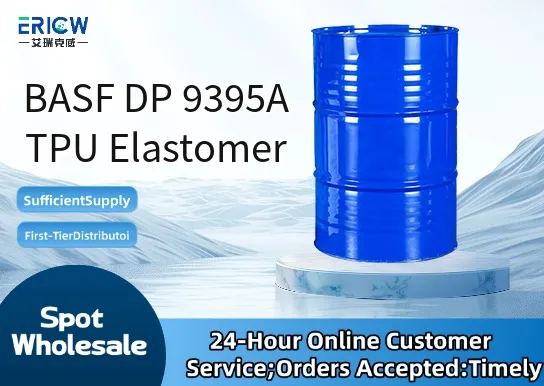
Excellent abrasion resistance for extended service life in demanding mechanical environments.
High tensile strength and elongation at break, enabling robust performance under dynamic stress.
Good low-temperature flexibility down to –40 °C without significant loss of elasticity.
Outstanding resistance to oils, greases, and many common industrial solvents.
Processable via standard thermoplastic methods including extrusion, injection molding, and calendering.
Industrial hoses and hydraulic tubing requiring high pressure and chemical resilience.
Dynamic seals and gaskets for automotive and machinery applications.
Wear-resistant conveyor belts and scraper blades in material handling systems.
Flexible protective sheathing for cables and wires in harsh environments.
High-performance footwear components such as midsoles and outsoles.
| Chemical Type | Thermoplastic Polyurethane (TPU), polyester-based |
| Product Form | Pellets |
| Appearance | Off-white to light beige, free-flowing granules |
| Hardness (Shore A) | 93–95 |
| Density (g/cm³) | 1.18–1.22 |
| Melt Flow Index (230 °C/2.16 kg, g/10 min) | 10–14 |
| Primary Applications | Extruded profiles, molded parts, flexible industrial components |
| Key Features | Oil resistance, high elasticity, excellent processability |
Q1: What is the primary function of BASF DP 9395A in thermoplastic polyurethane (TPU) formulations?
A: DP 9395A is a specialized processing aid designed to improve melt flow, reduce extrusion pressure, and enhance surface finish in TPU compounds—particularly during high-speed film casting, fiber spinning, and profile extrusion.
Q2: Is DP 9395A compatible with aromatic and aliphatic TPU base resins?
A: Yes, DP 9395A demonstrates broad compatibility across both aromatic and aliphatic TPU systems, including polyester- and polyether-based grades, without compromising mechanical integrity or long-term thermal stability.
Q3: How does DP 9395A affect the final product’s clarity and UV resistance?
A: When used at recommended levels, DP 9395A does not significantly impact optical clarity in transparent TPU applications and shows no adverse effect on inherent UV resistance—though overall weatherability remains dependent on the base polymer and any additional stabilizers present.
Q4: Can DP 9395A be added directly during compounding, or does it require pre-dispersion?
A: DP 9395A is typically incorporated directly into the TPU melt during extrusion compounding and disperses readily under standard shear conditions—no pre-dispersion or masterbatching is required for most industrial processes.
Contact With Us:
E-mail: wangxingqiang@ericwchem.com
Have a Questions? Call Us:
Add:
Building A1, Jiete Industrial Park, Huangpu District, Guangzhou City, Guangdong Province, China