English
 Español
 tiếng việt
 русский
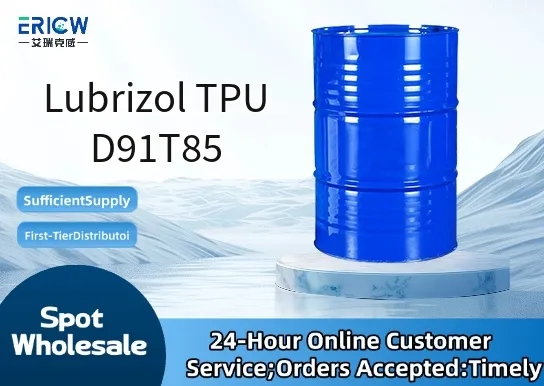
Excellent abrasion resistance for demanding dynamic service environments.
Outstanding low-temperature flexibility down to –40 °C.
Good hydrolytic stability, especially in warm, humid conditions.
High tensile strength and elongation retention after thermal aging.
Compatible with common processing methods including extrusion, injection molding, and calendering.
Automotive interior trim components requiring soft-touch feel and durability.
Industrial hoses and pneumatic tubing subject to repeated flexing.
Protective overmolding for electronic connectors and sensors.
Footwear midsoles and outsole compounds needing resilience and grip.
Medical tubing and fluid-handling components compliant with ISO 10993 pre-screening requirements.
| Chemical Type | Thermoplastic Polyurethane (TPU), Polyester-based |
| Product Form | Natural-colored pellets |
| Appearance | Opaque, uniform cylindrical pellets |
| Primary Applications | Extruded profiles, injection-molded parts, overmolded assemblies |
| Key Features | Abrasion resistance, low-temperature flexibility, hydrolysis resistance |
| Processing Method | Extrusion, Injection Molding, Calendering |
| Regulatory Compliance | Meets FDA 21 CFR §177.1680 for indirect food contact (subject to formulation) |
| Storage Recommendation | Store in original sealed packaging at ≤25 °C and <50% RH |
Q1: What is the primary function of Lubrizol TPU D91T85 in thermoplastic polyurethane (TPU) formulations?
A: Lubrizol TPU D91T85 is a high-performance processing aid designed to improve melt flow, reduce extrusion pressure, and enhance surface finish in TPU compounds—particularly during melt-processing operations such as extrusion and injection molding.
Q2: Is Lubrizol TPU D91T85 compatible with all major TPU chemistries (e.g., polyester-, polyether-, and polycaprolactone-based TPUs)?
A: Yes, it demonstrates broad compatibility across common TPU base resins. Performance may vary depending on molecular weight, hardness, and polarity of the host TPU, so formulation optimization is recommended for each specific system.
Q3: How is Lubrizol TPU D91T85 typically incorporated into TPU formulations?
A: It is generally added directly to the TPU resin prior to melt processing—either via dry blending or gravimetric feeding—and is fully dispersed during standard extrusion or compounding. Pre-compounding is not required, though uniform distribution is essential for consistent performance.
Q4: Does Lubrizol TPU D91T85 affect the mechanical properties or long-term stability of finished TPU parts?
A: When used at recommended dosage levels, it does not significantly compromise tensile strength, elongation, or thermal stability. In fact, improved dispersion and reduced shear history can contribute to more consistent mechanical performance across production batches.
Contact With Us:
E-mail: wangxingqiang@ericwchem.com
Have a Questions? Call Us:
Add:
Building A1, Jiete Industrial Park, Huangpu District, Guangzhou City, Guangdong Province, China