English
 Español
 tiếng việt
 русский
High clarity and excellent optical transparency for premium aesthetic performance.
Outstanding melt processability with low viscosity, enabling efficient extrusion and injection molding.
Good hydrolytic stability suitable for applications exposed to ambient humidity and moderate moisture.
Excellent abrasion resistance and dynamic mechanical durability under repeated flexing.
Non-plasticized formulation offering inherent low extractables and compliance readiness for regulated markets.
Medical tubing and fluid delivery components requiring clarity and biocompatibility support.
Consumer electronics protective casings and soft-touch overmolded grips.
High-end sporting goods components such as watch bands, gaskets, and wearable device housings.
Automotive interior trim elements including knobs, seals, and decorative accents.
Flexible packaging films and thermoformed blister packaging for premium consumer products.
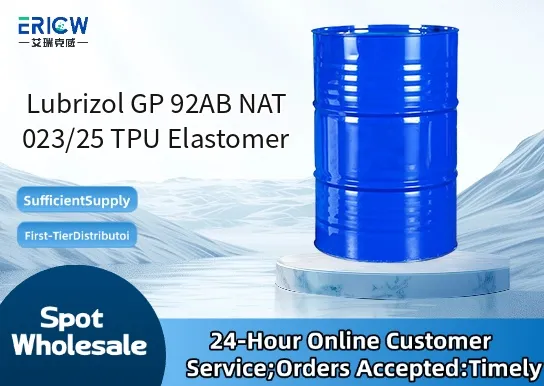
| Chemical Type | Aliphatic polyester-based thermoplastic polyurethane (TPU) |
| Product Form | Pellets |
| Appearance | Natural, translucent pellets |
| Hardness (Shore A) | 92 ± 2 |
| Melt Flow Rate (230 °C / 2.16 kg) | 23–25 g/10 min |
| Density (ASTM D792) | 1.18–1.20 g/cm³ |
| Primary Applications | Extrusion, injection molding, and blow molding of high-clarity elastomeric parts |
| Key Features | Clarity, melt stability, hydrolysis resistance, and processing versatility |
Q1: What is the primary function of Lubrizol GP 92AB NAT 023/25 in TPU formulations?
A: Lubrizol GP 92AB NAT 023/25 is a high-performance processing aid and surface modifier designed to improve melt flow, reduce extrusion torque, and enhance surface gloss and slip in thermoplastic polyurethane (TPU) compounds—without compromising mechanical integrity or thermal stability.
Q2: Is this additive compatible with all TPU chemistries (e.g., polyester- vs. polyether-based)?
A: Yes, GP 92AB NAT 023/25 demonstrates broad compatibility across common TPU base resins, including both polyester- and polyether-type TPUs. Compatibility should still be verified under actual processing conditions due to variations in molecular weight, hardness grade, and formulation complexity.
Q3: How is GP 92AB NAT 023/25 typically incorporated into TPU production?
A: It is commonly introduced via dry blending with TPU pellets prior to extrusion or injection molding. It may also be added directly into the extruder feed throat or via side-stuffer for continuous processes. Pre-blending ensures uniform dispersion and optimal performance at typical dosage levels.
Q4: Does this additive affect the regulatory status of finished TPU articles?
A: GP 92AB NAT 023/25 is not intended for direct food-contact or medical applications unless specifically validated by the end-user under applicable regulatory frameworks. Formulators are responsible for confirming final article compliance based on their specific use case, processing conditions, and regional requirements.
Contact With Us:
E-mail: wangxingqiang@ericwchem.com
Have a Questions? Call Us:
Add:
Building A1, Jiete Industrial Park, Huangpu District, Guangzhou City, Guangdong Province, China