English
 Español
 tiếng việt
 русский
High reactivity with standard amine and anhydride curing agents for rapid gelation and short cycle times.
Excellent adhesion to metals, composites, and treated plastics without primer requirement.
Low viscosity (12,000–15,000 cP at 25°C) enabling easy processing, impregnation, and air bubble release.
Good thermal stability with glass transition temperature (Tg) up to 135°C after full cure.
Low chloride content (< 800 ppm), ensuring high electrical insulation performance and corrosion resistance.
Electrical encapsulation of transformers, reactors, and high-voltage insulators.
Structural adhesive formulation for aerospace composite bonding and automotive lightweight assemblies.
Matrix resin for filament-wound pressure vessels and fiber-reinforced polymer (FRP) tanks.
Coating and lining systems for chemical-resistant industrial flooring and tank interiors.
Prepreg and infusion resins in wind turbine blade manufacturing.
| Chemical Type | Bisphenol-A based liquid epoxy resin |
| Product Form | Clear to pale yellow viscous liquid |
| Appearance | Homogeneous, transparent, free from gels or suspended particles |
| Epoxy Equivalent Weight (EEW) | 184–190 g/eq |
| Viscosity (25°C) | 12,000–15,000 cP |
| Chlorine Content | ≤ 800 ppm |
| Volatiles Content | ≤ 0.3 wt% |
| Storage Stability | 12 months at ≤ 25°C in unopened original packaging |
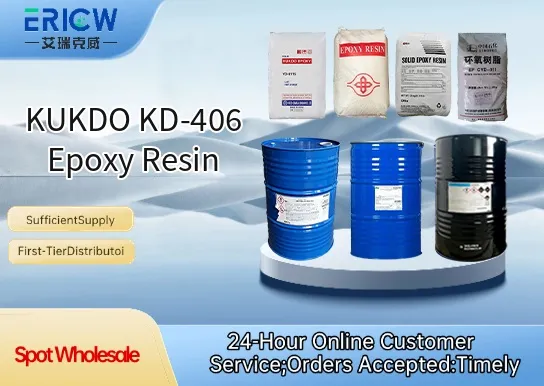
Q1: What is the primary functional role of KD-406 in epoxy formulations?
A: KD-406 is a reactive liquid epoxy resin modifier designed to reduce system viscosity, improve flexibility, and enhance compatibility with various curing agents—without significantly compromising thermal stability or chemical resistance.
Q2: Is KD-406 suitable for use in high-gloss coatings or clear protective topcoats?
A: Yes—its low volatility, excellent clarity, and minimal yellowing tendency make it well-suited for high-performance decorative and protective coatings where optical clarity and long-term gloss retention are critical.
Q3: How does KD-406 compare to standard DGEBA resins in terms of reactivity and cure profile?
A: KD-406 exhibits slightly lower epoxy equivalent weight than conventional DGEBA resins, resulting in moderately increased crosslink density and faster initial cure response—particularly with amine-based hardeners—though full cure kinetics remain highly dependent on formulation and thermal schedule.
Q4: Can KD-406 be used in food-contact compliant epoxy systems?
A: KD-406 is intended for industrial and protective applications; its suitability for food-contact applications depends entirely on final formulation compliance, regulatory evaluation, and end-use approval—users must verify conformance with applicable regional food safety regulations through qualified testing and documentation.
Contact With Us:
E-mail: wangxingqiang@ericwchem.com
Have a Questions? Call Us:
Add:
Building A1, Jiete Industrial Park, Huangpu District, Guangzhou City, Guangdong Province, China