English
 Español
 tiếng việt
 русский
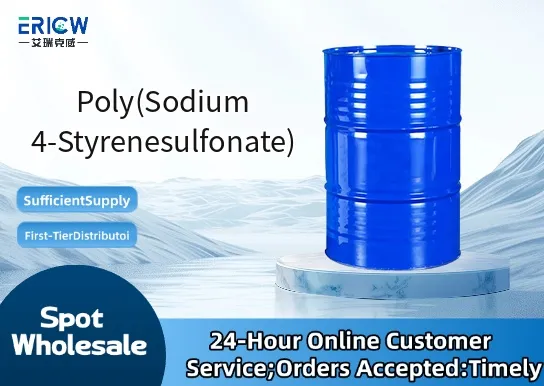
Highly water-soluble anionic polyelectrolyte with excellent colloidal stability in aqueous media.
Precise molecular weight control available across standard grades (Mw: 70k–1,000k Da) for tailored rheology and charge density.
Thermally stable up to 250 °C (decomposition onset), enabling compatibility with high-temperature processing.
Non-toxic, non-volatile, and free of residual monomers or organic solvents when purified per ISO 9001 protocols.
Consistent sulfonation degree (>99% at the para-position), ensuring predictable ionic strength and electrostatic behavior.
Dispersant and stabilizer for aqueous pigment dispersions in water-based inks and coatings.
Charge-control agent in electrophoretic display (EPD) and electronic paper (e-Paper) formulations.
Template and dopant in conductive polymer synthesis (e.g., PEDOT:PSS enhancement).
Antifouling layer component in ultrafiltration and nanofiltration membrane surface modification.
Model polyanion in biomedical research for studying polyelectrolyte–protein interactions and drug delivery carrier design.
| Chemical Type | Linear anionic synthetic polymer, sodium salt of poly(4-styrenesulfonic acid) |
| Product Form | White to off-white hygroscopic powder or lyophilized solid |
| Appearance | Free-flowing granular or fine powder; no visible impurities |
| Molecular Weight (Mw) | 70,000 – 1,000,000 Da (certified by multi-angle light scattering, MALS) |
| Residual Monomer (Styrene) | < 10 ppm (by GC-MS) |
| pH (1% w/v aqueous solution) | 6.0 – 7.5 |
| Sulfonation Degree | > 99 mol% (confirmed by 1H NMR) |
| Regulatory Compliance | REACH registered; compliant with USP <467> Class 3 residual solvents; no SVHC listed |
| Common Compatible Systems | Suitability |
| Aqueous acrylic emulsions | Highly Recommended – Enhances dispersion stability and freeze-thaw resistance without coagulation |
| PEDOT:PSS formulations | Highly Recommended – Improves conductivity and film uniformity via charge screening and morphology control |
| Cellulose nanocrystal (CNC) suspensions | Recommended – Enables electrostatic stabilization and prevents aggregation at low ionic strength |
| Polyvinyl alcohol (PVA) blends | Suitable – Forms miscible films with tunable hydrophilicity; requires pH adjustment to avoid precipitation |
Q1: What is the CAS Registry Number for Poly(Sodium 4-Styrenesulfonate)?
A: The CAS number is 25137-90-2. Note that this identifier applies to the generic polymer; specific MW grades may carry additional batch-specific documentation.
Q2: What is the typical usage concentration range in aqueous dispersions?
A: Standard dosage ranges from 0.1–2.0 wt% relative to total solids, depending on particle surface charge and desired stabilization threshold; optimization via zeta potential titration is recommended.
Q3: How does it compare to polyacrylic acid (PAA) in terms of ionic strength tolerance?
A: PSSNa exhibits superior salt tolerance versus PAA due to its rigid aromatic backbone and localized sulfonate charge — maintains viscosity and dispersion stability up to 0.5 M NaCl, whereas PAA typically precipitates above 0.1 M.
Q4: Is Poly(Sodium 4-Styrenesulfonate) approved for food-contact applications?
A: It is not authorized under FDA 21 CFR for direct food contact; however, it is widely used in non-migrating industrial coatings and membranes where leaching is precluded by crosslinking or barrier design.
Q5: Does it exhibit measurable migration or extraction in aqueous environments?
A: Migration is negligible under ambient conditions due to high molecular weight and strong hydration shell; validated extraction studies (EN 13130-1) show < 0.05 mg/kg in deionized water after 10 days at 40 °C.
Contact With Us:
E-mail: wangxingqiang@ericwchem.com
Have a Questions? Call Us:
Add:
Building A1, Jiete Industrial Park, Huangpu District, Guangzhou City, Guangdong Province, China