English
 Español
 tiếng việt
 русский
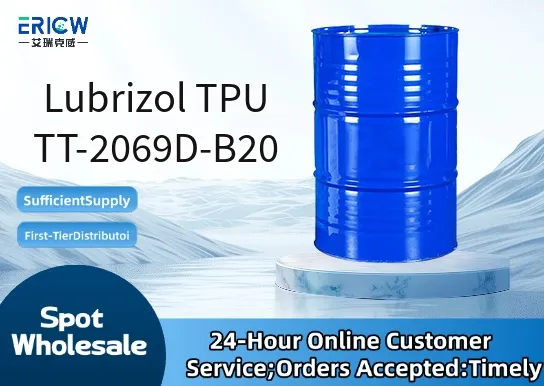
Excellent abrasion resistance for demanding dynamic applications.
Outstanding low-temperature flexibility down to –40 °C.
Good oil and grease resistance suitable for industrial environments.
High melt flow index enabling efficient processing via extrusion and injection molding.
Consistent batch-to-batch performance supported by Lubrizol’s stringent quality control.
Automotive interior trim components including seals, gaskets, and soft-touch overlays.
Industrial hoses and pneumatic tubing requiring flex-life durability.
Consumer electronics protective casings and wearable device bands.
Medical device tubing and non-implantable fluid-handling components.
Footwear midsoles and outsole compounds requiring rebound and wear resilience.
| Chemical Type | Thermoplastic Polyurethane (Aliphatic Polyester-based) |
| Product Form | Pellets |
| Appearance | Opaque off-white to light tan granules |
| Primary Applications | Extrusion, injection molding, and blow molding |
| Key Features | Abrasion resistance, low-temperature flexibility, processability |
| Benefits | Reduced part failure in cyclic loading, extended service life, broad processing window |
| Density (ASTM D792) | 1.18–1.20 g/cm³ |
| Melt Flow Index (230 °C/2.16 kg, ASTM D1238) | 15–22 g/10 min |
Q1: What is the primary function of Lubrizol TPU TT-2069D-B20 in thermoplastic polyurethane (TPU) formulations?
A: Lubrizol TPU TT-2069D-B20 is a high-performance processing aid and surface modifier designed to enhance melt flow, reduce extrusion pressure, and improve surface gloss and clarity in TPU compounds—particularly during extrusion and injection molding processes.
Q2: Is TT-2069D-B20 compatible with all major TPU chemistries (e.g., polyester-, polyether-, and polycaprolactone-based TPUs)?
A: Yes, TT-2069D-B20 demonstrates broad compatibility across common TPU base resins. It is especially effective in aromatic polyester-based TPUs but has also been successfully evaluated in polyether and aliphatic systems—compatibility should be confirmed via small-scale formulation trials under intended processing conditions.
Q3: How does TT-2069D-B20 affect the mechanical properties of finished TPU parts?
A: When used at recommended dosage levels, TT-2069D-B20 typically maintains key mechanical properties—including tensile strength, elongation at break, and tear resistance—while significantly improving processability. Minor reductions in modulus may occur at higher loadings, so optimization is advised for performance-critical applications.
Q4: Can TT-2069D-B20 be used in applications requiring FDA compliance or food-contact suitability?
A: TT-2069D-B20 is not pre-approved for direct food-contact applications under FDA or EU regulations. Its use in food-contact or medical-grade TPU formulations requires full regulatory evaluation by the end-user, including migration testing and compliance verification per applicable jurisdictional requirements.
Contact With Us:
E-mail: wangxingqiang@ericwchem.com
Have a Questions? Call Us:
Add:
Building A1, Jiete Industrial Park, Huangpu District, Guangzhou City, Guangdong Province, China