English
 Español
 tiếng việt
 русский
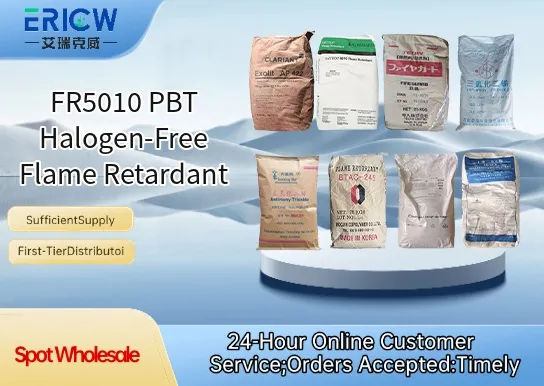
UL94 V-0 rated at 1.6 mm thickness without dripping or afterglow.
Phosphorus-based, halogen-free formulation ensuring low smoke density and minimal corrosive gas emission during combustion.
Excellent thermal stability compatible with standard PBT polymer processing temperatures (230–260 °C).
Maintains high mechanical performance—retains >90% tensile strength and impact resistance of base PBT resin.
Good dispersion and compatibility with glass-fiber-reinforced PBT compounds.
Electrical connectors and housings for automotive ECUs and charging systems.
Consumer electronics enclosures including power adapters, smart home hubs, and USB-C accessories.
Industrial control components such as relay bases, terminal blocks, and sensor housings.
LED lighting modules and driver housings requiring RoHS-compliant, flame-retarded thermoplastics.
Medical device casings where low halogen content and regulatory compliance are critical.
| Chemical Type | Organophosphorus compound |
| Product Form | Pellets |
| Appearance | Off-white to light beige free-flowing pellets |
| Primary Applications | Flame retardant additive for PBT and PBT/glass fiber blends |
| Key Features | Halogen-free, UL94 V-0 compliant, RoHS 2015/863/EU compliant |
| Recommended Loading Level | 12–15 wt% in PBT resin |
| Storage Conditions | Store in dry, cool conditions (<25 °C); keep sealed to prevent moisture absorption |
| Regulatory Compliance | REACH SVHC-free, no PFAS, no antimony trioxide |
Q1: What is the primary polymer matrix FR5010 is designed for?
A: FR5010 is specifically engineered for polybutylene terephthalate (PBT) resins, delivering effective halogen-free flame retardancy while maintaining good mechanical properties and processability in standard PBT formulations.
Q2: How does FR5010 achieve flame retardancy without halogens?
A: FR5010 operates via a condensed-phase mechanism, promoting char formation on the polymer surface during thermal decomposition. This protective char layer insulates the underlying material and reduces fuel feed to the flame, eliminating the need for halogen-based chemistry.
Q3: Is FR5010 compatible with common PBT additives such as impact modifiers or glass fibers?
A: Yes, FR5010 demonstrates good compatibility with standard PBT additives including impact modifiers, glass fibers, and thermal stabilizers. However, formulation optimization—including dispersion and thermal history—is recommended to ensure consistent performance and avoid potential interactions.
Q4: What processing methods is FR5010 suitable for in PBT applications?
A: FR5010 is well-suited for conventional thermoplastic processing techniques used with PBT, including injection molding and extrusion. It exhibits good thermal stability under typical PBT processing temperatures and shows minimal volatilization or plate-out.
Q5: Does FR5010 affect the electrical insulation properties of PBT?
A: FR5010 is formulated to preserve the inherent dielectric performance of PBT. When properly dispersed and compounded, it maintains high volume resistivity and low dissipation factor—key requirements for electrical and electronic housing applications.
Contact With Us:
E-mail: wangxingqiang@ericwchem.com
Have a Questions? Call Us:
Add:
Building A1, Jiete Industrial Park, Huangpu District, Guangzhou City, Guangdong Province, China