English
 Español
 tiếng việt
 русский
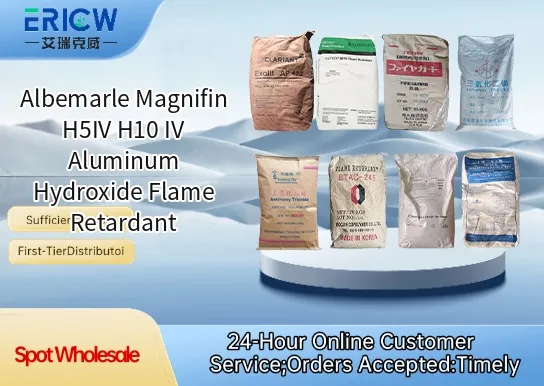
High-purity, surface-treated aluminum hydroxide offering excellent flame retardancy and smoke suppression.
Optimized particle size distribution for improved dispersion and loading efficiency in polymer matrices.
Low abrasivity minimizes wear on processing equipment during compounding and extrusion.
Halogen-free and environmentally compliant, supporting RoHS, REACH, and UL 94 V-0/V-1 requirements.
Thermally stable up to ~300 °C, enabling compatibility with common thermoplastics including PP, PE, and EVA.
Wire and cable insulation and jacketing compounds.
Automotive interior components requiring low-smoke, halogen-free fire performance.
Building and construction materials, including thermoplastic floor coverings and ceiling panels.
Electrical enclosures and housings for consumer electronics and industrial equipment.
Flexible and rigid PVC-free flooring and roofing membranes.
| Chemical Type | Aluminum hydroxide, Al(OH)₃ |
| Product Form | Free-flowing white powder |
| Appearance | White, odorless, non-toxic powder |
| Primary Applications | Flame retardant filler for polymers, elastomers, and coatings |
| Key Features | Surface-modified for enhanced polymer compatibility |
| Benefits | Reduces heat release rate (HRR) and total smoke production (TSP) |
| Density (g/cm³) | 2.40–2.45 |
| pH (10% aqueous slurry) | 7.0–8.5 |
Q1: What is the primary function of Magnifin H5IV and H10 IV in polymer formulations?
A: Magnifin H5IV and H10 IV are surface-treated aluminum hydroxide grades designed to act as halogen-free flame retardants and smoke suppressants. They decompose endothermically upon heating, releasing water vapor that cools the substrate and dilutes flammable gases — helping polymers meet key fire safety requirements without compromising processability or mechanical performance.
Q2: How do the H5IV and H10 IV variants differ in application suitability?
A: H5IV offers a finer particle size distribution and higher specific surface area, making it especially suitable for applications requiring superior dispersion and enhanced flame retardancy in thin-section or high-clarity compounds — such as wire & cable jackets and thermoplastic elastomers. H10 IV provides a slightly coarser, more robust particle morphology, offering improved flow and packing characteristics in high-loading applications like rigid PVC profiles and engineering thermoplastics.
Q3: Are these grades compatible with common polymer processing methods?
A: Yes — both H5IV and H10 IV are engineered for compatibility with extrusion, injection molding, and calendering. Their proprietary surface treatment enhances interfacial adhesion with non-polar and semi-crystalline polymers (e.g., polyolefins, PVC, TPEs), supporting stable melt flow and reduced agglomeration during high-shear processing.
Q4: Do Magnifin H5IV and H10 IV require additional synergists to achieve target flame performance?
A: These grades are effective as standalone flame retardants in many formulations, particularly where moderate fire resistance is required. However, for demanding standards (e.g., UL 94 V-0 at thin wall sections or improved tracking resistance), they are often combined with synergists such as zinc borate or melamine polyphosphate — the choice depending on the polymer matrix and regulatory environment.
Contact With Us:
E-mail: wangxingqiang@ericwchem.com
Have a Questions? Call Us:
Add:
Building A1, Jiete Industrial Park, Huangpu District, Guangzhou City, Guangdong Province, China