English
 Español
 tiếng việt
 русский
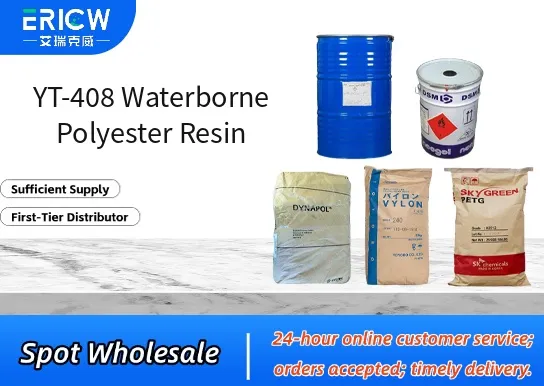
Low-VOC formulation compliant with global environmental regulations including EU REACH and US EPA standards.
Excellent hydrolytic stability for extended shelf life and consistent performance in aqueous systems.
Good compatibility with acrylic emulsions, polyurethane dispersions, and crosslinkers such as aziridines and carbodiimides.
Provides balanced hardness, flexibility, and film clarity in cured coatings.
Enables fast ambient-temperature film formation with low coalescent demand.
High-performance waterborne industrial maintenance coatings for metal substrates.
Architectural and decorative topcoats requiring mar resistance and gloss retention.
Interior wood coatings for furniture and cabinetry where low odor and rapid dry-through are critical.
Base resin for two-component (2K) waterborne polyurethane topcoats.
| Chemical Type | Aliphatic waterborne polyester dispersion |
| Product Form | Opaque white to off-white liquid |
| Appearance | Homogeneous dispersion, no sedimentation |
| pH (at 25°C) | 7.5 – 8.5 |
| Solids Content (wt%) | 35.0 ± 1.5 |
| Viscosity (mPa·s, Brookfield RVT, #2 spindle, 20 rpm, 25°C) | 150 – 400 |
| Particle Size (D50, nm) | 80 – 120 |
| Minimum Film Formation Temperature (MFFT, °C) | 12 – 16 |
Q1: What are the primary application areas for YT-408?
A: YT-408 is commonly used in waterborne industrial coatings, including metal primers, topcoats for general-purpose equipment, and protective finishes for interior architectural applications where low VOC content and good film formation are required.
Q2: How does YT-408 compare to solvent-based polyester resins in terms of performance?
A: YT-408 delivers comparable hardness, gloss retention, and chemical resistance after full cure, though drying and curing kinetics may differ due to its waterborne nature. It typically requires careful coalescent selection and thermal or ambient crosslinking depending on the formulation design.
Q3: Is YT-408 compatible with common crosslinkers used in waterborne systems?
A: Yes — YT-408 is formulated to be compatible with melamine-formaldehyde resins, blocked isocyanates, and carbodiimide-based crosslinkers, enabling flexible cure profiles from ambient to forced-dry conditions.
Q4: What viscosity and pH range should be expected for YT-408 in its supplied form?
A: YT-408 is supplied as a stable aqueous dispersion with a medium-solids content. Its viscosity is suitable for conventional coating application methods, and its pH is maintained in the mildly acidic to neutral range to ensure colloidal stability and compatibility with common additives.
Q5: Can YT-408 be used in formulations requiring FDA-compliant or food-contact-safe coatings?
A: YT-408 is not inherently certified for direct food contact. Any use in food-related applications would require full formulation evaluation, regulatory review, and third-party verification based on final cured film properties and intended exposure conditions.
Contact With Us:
E-mail: wangxingqiang@ericwchem.com
Have a Questions? Call Us:
Add:
Building A1, Jiete Industrial Park, Huangpu District, Guangzhou City, Guangdong Province, China