English
 Español
 tiếng việt
 русский
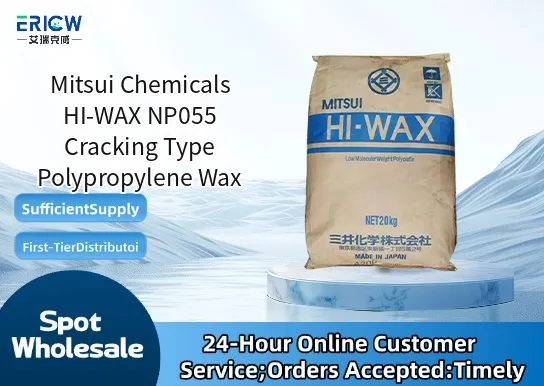
Highly controlled molecular weight distribution for consistent performance in demanding compounding processes.
Excellent thermal stability and low volatility, supporting high-temperature extrusion and injection molding operations.
Superior dispersion capability in polymer matrices, enhancing filler and pigment distribution in masterbatches.
Low melt viscosity at processing temperatures, improving flow behavior and reducing energy consumption during melt blending.
Clean cracking-type production process yields low odor and minimal extractables—ideal for sensitive applications including food-contact-graded compounds (subject to regulatory approval).
Polyolefin-based color and additive masterbatches for automotive interior components.
Slip and anti-block additives in BOPP and CPP film formulations.
Processing aid in filled polypropylene compounds containing talc, calcium carbonate, or glass fiber.
Surface modifier in engineering thermoplastics to improve mold release and part ejection efficiency.
Compatibilizer and rheology modifier in PP/PE blends and recycled polyolefin systems.
| Chemical Type | Cracking-type polypropylene homopolymer wax |
| Product Form | Pellets or flake (standard packaging: 25 kg multi-wall paper bags with PE liner) |
| Appearance | Off-white to light yellow semi-crystalline solid |
| Melt Point (°C, ASTM D3418) | 145–152 |
| Penetration @ 25°C (0.1 mm, ASTM D1321) | 2–6 |
| Viscosity @ 190°C (mPa·s, ASTM D3236) | 15–25 |
| Density @ 23°C (g/cm³, ASTM D792) | 0.89–0.91 |
| Volatile Matter (wt%, ASTM D6372) | ≤ 0.3 |
Contact With Us:
E-mail: wangxingqiang@ericwchem.com
Have a Questions? Call Us:
Add:
Building A1, Jiete Industrial Park, Huangpu District, Guangzhou City, Guangdong Province, China