English
 Español
 tiếng việt
 русский
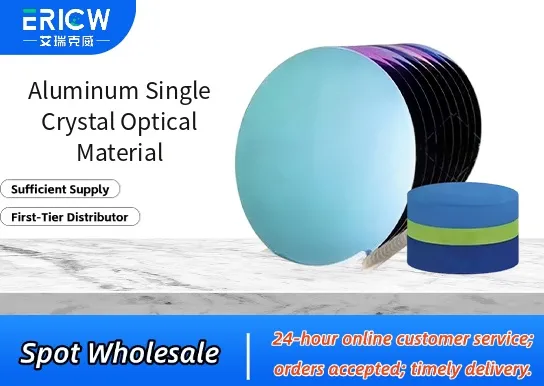
Exceptional optical transparency in the ultraviolet (UV) to near-infrared (NIR) spectral range (180–1500 nm).
Ultra-low intrinsic scattering and minimal lattice defects due to single-crystal structure and zone-refined purity.
High thermal conductivity (>235 W/m·K at 25°C) enabling stable performance under high-power optical loading.
Excellent mechanical stability and resistance to thermal shock, supporting precision mounting in vacuum and cryogenic environments.
Native oxide layer provides passive corrosion resistance while maintaining surface polishability for high-reflectivity coatings.
Substrates for high-damage-threshold UV laser mirrors and harmonic generation optics.
Windows and lenses in synchrotron beamline instrumentation requiring low X-ray absorption and high thermal stability.
Reference standards in metrology-grade interferometry and ellipsometry systems.
Cryogenic optical components for space-based telescopes and quantum sensing platforms.
Targets and diagnostics in ultrafast laser–matter interaction experiments.
| Chemical Type | Elemental aluminum (Al), 99.999% (5N) purity |
| Product Form | Orientation-controlled single crystal wafers or polished discs (e.g., [100], [111] orientations) |
| Appearance | Silvery metallic, mirror-polished surface; no grain boundaries or polycrystalline inclusions |
| Melting Point | 660.3 °C |
| Primary Applications | High-precision optical substrates, UV/NIR transmission windows, laser cavity components |
| Key Features | Single-domain crystallinity, low dislocation density (<100 cm⁻²), controlled surface roughness (Ra < 0.3 nm) |
| Benefits | Reduced wavefront distortion, enhanced coating adhesion, predictable thermal expansion behavior (α ≈ 23.1 × 10⁻⁶/K) |
| Regulatory Compliance | RoHS-compliant; REACH SVHC-free; no intentional addition of restricted substances |
| Common Compatible Systems | Suitability |
| UV Excimer Laser Systems (e.g., ArF, KrF) | Highly Recommended – Excellent transmission at 193 nm and 248 nm with minimal solarization |
| Ultra-High Vacuum (UHV) Optical Chambers | Highly Recommended – Low outgassing rate (<1×10⁻¹⁰ mbar·L/s·cm²) after proper bake-out |
| Electron Beam Evaporation Coating Platforms | Recommended – Compatible with Al, MgF₂, SiO₂, and dielectric stack depositions |
| Cryogenic Optical Mounts (4 K to 77 K) | Suitable – Maintains structural integrity and optical flatness across thermal cycling |
Q1: What is the CAS Registry Number for high-purity aluminum used in single crystal optical material?
A: The CAS number for elemental aluminum is 7429-90-5; this applies to the base material — no additional CAS is assigned to the single-crystal form as it is a physical allotrope, not a chemical compound.
Q2: Is there a risk of aluminum ion migration or leaching when used in contact with aqueous or humid optical environments?
A: No significant ionic migration occurs under standard optical use conditions; the native Al₂O₃ layer (2–5 nm thick) is highly stable and non-soluble in neutral/humid air. Leaching is only observed under prolonged exposure to strong acids, alkalis, or halogenated solvents — not relevant to typical optical deployment.
Q3: How does aluminum single crystal compare to sapphire (Al₂O₃) or fused silica for UV optical applications?
A: Aluminum single crystal offers superior thermal conductivity and lower density than sapphire, but transmits only down to ~180 nm (vs. sapphire’s ~150 nm cutoff). Unlike fused silica, it is reflective in UV without coatings — making it ideal for uncoated mirrors, though not for deep-UV transmission optics.
Q4: Does this material comply with ISO 10110 optical surface quality standards?
A: Yes — standard wafers meet ISO 10110-7:2017 specification for surface imperfections (scratch-dig ≤ 10-5) and ISO 10110-3:2019 for surface figure (λ/10 @ 633 nm typical). Custom metrology reports available upon request.
Contact With Us:
E-mail: wangxingqiang@ericwchem.com
Have a Questions? Call Us:
Add:
Building A1, Jiete Industrial Park, Huangpu District, Guangzhou City, Guangdong Province, China