English
 Español
 tiếng việt
 русский
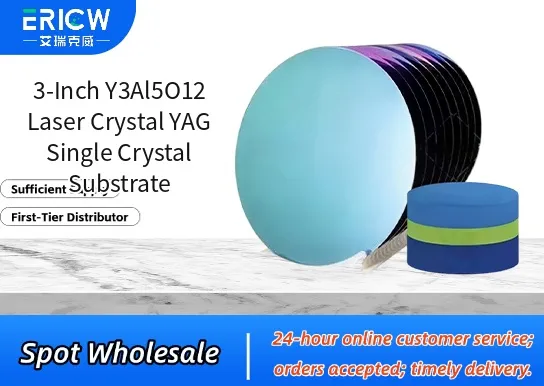
High optical homogeneity with ≤10⁻⁶ wavefront distortion over full 76.2 mm aperture.
Ultra-low absorption coefficient (<0.005 cm⁻¹) at 1064 nm, enabling high-efficiency laser amplification.
Excellent thermal conductivity (11 W/m·K at 300 K) for stable high-power CW and pulsed operation.
Single-crystal Czochralski-grown structure with dislocation density <50 cm⁻² and no grain boundaries.
Polished to λ/10 surface flatness (RMS) and 10–5 scratch-dig specification on both faces.
Active gain medium in high-energy Nd:YAG and Yb:YAG solid-state laser systems.
Substrate for epitaxial growth of rare-earth-doped thin-film laser structures (e.g., Er:YAG, Tm:YAG).
Frequency-doubling and Q-switching cavity components in industrial and medical laser platforms.
Reference standard for calibration of laser-induced damage threshold (LIDT) measurement setups.
Optical bench platform for ultrafast laser pulse compression and parametric oscillation experiments.
| Chemical Type | Yttrium Aluminum Garnet (Y₃Al₅O₁₂), stoichiometric single crystal |
| Product Form | Round polished substrate, 76.2 mm (3-inch) diameter, thickness 1.0–5.0 mm (customizable) |
| Crystal Orientation | <111> or <100> (standard); other orientations available upon request |
| Surface Finish | Double-side polished (DSP), λ/10 @ 633 nm, parallelism ≤5 arcsec |
| Melting Point | 1970 ± 20 °C (per ASTM E1113) |
| Primary Applications | Laser gain media, nonlinear optics substrates, precision optical reference platforms |
| Key Features | Non-hygroscopic, radiation-hardened, vacuum-compatible, low birefringence |
| Regulatory Compliance | RoHS 2015/863/EU compliant; REACH SVHC-free; no export-controlled additives |
| Common Compatible Systems | Suitability |
| Coherent AVIA LX Series DPSS Lasers | Highly Recommended – Optimized thermal lensing match and pump absorption profile |
| IPG Photonics YLR-Series Fiber-Pumped YAG Amplifiers | Highly Recommended – Validated for >5 kW average power operation with minimal depolarization |
| Trumpf TruMicro 5000 Ultrafast Laser Platforms | Recommended – Suitable for regenerative amplifier seeding with <100 fs pulse preservation |
| Quantel Brilliant B Nd:YAG Oscillators | Suitable – Compatible with standard 3-inch mount fixtures and water-cooled heat sinks |
Q1: What is the CAS Registry Number for Y₃Al₅O₁₂ (YAG) crystal?
A: Y₃Al₅O₁₂ has no CAS number as a crystalline material—CAS numbers apply only to chemical substances in defined molecular or ionic forms; bulk single-crystal YAG is assigned EC Number 235-053-7 and listed under EINECS as “Yttrium aluminium oxide”.
Q2: Is there a recommended maximum laser fluence or average power density for this substrate?
A: At 1064 nm, the laser-induced damage threshold (LIDT) is ≥15 J/cm² for 10 ns pulses (10 Hz, Ø0.5 mm spot) and ≥5 kW/cm² average power density for CW operation with active cooling (ΔT < 15 K across crystal).
Q3: How does undoped YAG substrate compare to Ce:YAG or Nd:YAG in terms of thermal and optical stability?
A: Undoped YAG exhibits superior thermal shock resistance and lower thermo-optic coefficient (dn/dT = 7.3×10⁻⁶ K⁻¹) versus doped variants; absence of activator ions eliminates concentration quenching and photodarkening, ensuring long-term transmission stability under UV/VIS/NIR irradiation.
Q4: Are there any known extractables or leachables from YAG substrates under high-temperature or vacuum conditions?
A: No detectable elemental leaching occurs below 1200 °C in vacuum or inert atmosphere; ICP-MS analysis of rinse solutions after 24 h ultrasonic cleaning in deionized water shows impurity levels <0.1 ppb for Y, Al, and O-related species.
Contact With Us:
E-mail: wangxingqiang@ericwchem.com
Have a Questions? Call Us:
Add:
Building A1, Jiete Industrial Park, Huangpu District, Guangzhou City, Guangdong Province, China