English
 Español
 tiếng việt
 русский
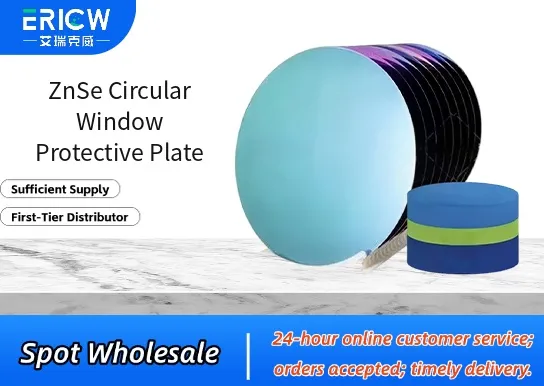
High transmission (>70%) across mid-infrared spectrum (2–12 µm), ideal for CO₂ laser optics protection.
Chemically inert and non-hygroscopic—resists degradation in humid or reactive industrial environments.
Hardness of ~4.5 Mohs ensures robust resistance to scratching and mechanical abrasion during handling and installation.
Thermally stable up to 350 °C, enabling reliable performance in high-power laser and thermal imaging systems.
Precision-polished surface with λ/4 surface flatness and <5 Å RMS roughness for minimal wavefront distortion.
Protective barrier for CO₂ laser cutting and welding optical assemblies in industrial manufacturing.
Front-end window in FTIR spectrometers requiring broadband IR transparency and environmental sealing.
Hermetic viewport in vacuum chambers used for semiconductor process monitoring and thin-film deposition.
Environmental shield in thermal imaging cameras operating in harsh field conditions (e.g., defense, aerospace).
Secondary protective layer in multi-stage optical housings for medical laser delivery systems (e.g., dermatology, surgery).
| Chemical Type | Zinc Selenide (ZnSe) |
| Product Form | Polished circular window plate, uncoated (AR coating optional) |
| Appearance | Transparent orange-yellow disc, free of bubbles, striae, or inclusions |
| Melting Point | 1525 °C (per ASTM E1137) |
| Primary Applications | Infrared optics protection, laser system front-end windows, spectroscopic viewports |
| Key Features | Low absorption coefficient (<0.0005 cm⁻¹ @ 10.6 µm), isotropic crystalline structure |
| Benefits | Extends lifetime of sensitive downstream optics; reduces maintenance downtime and alignment recalibration |
| Regulatory Compliance | RoHS 2015/863 compliant; REACH SVHC-free (as per latest candidate list) |
| Common Compatible Systems | Suitability |
| CO₂ Laser Cutting Systems (e.g., Trumpf TruLaser, Bystronic Bystar) | Highly Recommended – Optimized for 10.6 µm wavelength with minimal thermal lensing |
| FTIR Spectrometers (e.g., Thermo Nicolet iS50, Bruker Tensor II) | Highly Recommended – Meets spectral purity and beam deviation requirements per ISO 10110-5 |
| Vacuum Deposition Chambers (e.g., Kurt J. Lesker Auto500) | Recommended – Compatible with UHV conditions (<1×10⁻⁸ mbar); low outgassing rate (<1×10⁻¹² Pa·m³/s·cm²) |
| Thermal Imaging Gimbals (e.g., FLIR Axiom, Teledyne DALSA Genie Nano-IR) | Suitable – Requires optional anti-reflective coating for optimal signal-to-noise ratio at operational bands |
Q1: What is the CAS Registry Number for ZnSe material used in this protective plate?
A: The base ZnSe compound has CAS No. 1315-09-9; all plates are manufactured from high-purity (99.999% trace metal basis) ZnSe ingots certified per ASTM F2617.
Q2: Is there a recommended maximum optical power density for continuous-wave (CW) use?
A: For uncoated ZnSe plates, the damage threshold is ≥1.5 GW/cm² for 10 ns pulses at 10.6 µm; for CW operation, we recommend ≤5 kW/cm² with active cooling and proper beam homogenization.
Q3: How does ZnSe compare to Ge or CaF₂ for IR window applications?
A: ZnSe offers broader mid-IR transmission than Ge (which absorbs <2 µm) and higher laser damage resistance than CaF₂; unlike CaF₂, it is non-hygroscopic and requires no hermetic sealing in ambient air.
Q4: Does this product comply with USP <87> and <88> for extractables testing?
A: While not intended for pharmaceutical contact, ZnSe plates have undergone extractables profiling per USP <87> (in vitro cytotoxicity) and passed; full USP <88> (implantation) testing is not applicable due to non-biomedical end-use design.
Contact With Us:
E-mail: wangxingqiang@ericwchem.com
Have a Questions? Call Us:
Add:
Building A1, Jiete Industrial Park, Huangpu District, Guangzhou City, Guangdong Province, China