English
 Español
 tiếng việt
 русский
Low-VOC, environmentally compliant formulation meeting stringent global regulatory requirements.
Excellent film-forming capability with high gloss retention and superior clarity.
Outstanding abrasion resistance and flexibility for durable protective coatings.
Good compatibility with acrylic emulsions and common waterborne additives.
Stable storage performance at 5–40°C without viscosity drift or phase separation.
Waterborne wood coatings for furniture and interior flooring.
Leather finishing topcoats requiring soft hand feel and scuff resistance.
Plastic substrates coating for automotive interior trim and electronics housings.
Industrial maintenance coatings for metal and concrete surfaces.
High-performance overprint varnishes in flexible packaging laminates.
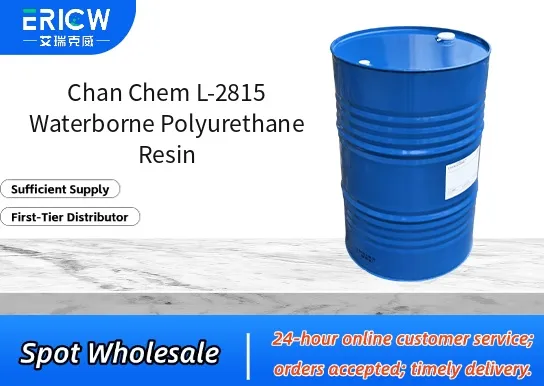
| Chemical Type | Aliphatic waterborne polyurethane dispersion |
| Product Form | Ready-to-use aqueous dispersion |
| Appearance | Translucent, slightly bluish milky liquid |
| pH (at 25°C) | 7.8–8.4 |
| Solids Content (wt%) | 30.0 ± 1.0 |
| Viscosity (mPa·s, Brookfield RVT, #2 spindle, 20 rpm, 25°C) | 150–350 |
| Density (g/cm³, 25°C) | 1.01–1.03 |
| Minimum Film Formation Temperature (MFFT) | ≈12°C |
Q1: What are the primary application areas for Chan Chem L-2815?
A: Chan Chem L-2815 is widely used in waterborne coatings for flexible substrates—including synthetic leather, textiles, and automotive interior trim—where excellent film flexibility, abrasion resistance, and low-VOC performance are required.
Q2: Is L-2815 compatible with other waterborne resins or additives?
A: Yes, L-2815 demonstrates good compatibility with common waterborne acrylics, polyacrylates, and crosslinkers such as aziridines or carbodiimides. Compatibility testing under specific formulation conditions is recommended prior to full-scale use.
Q3: How should L-2815 be stored and handled to maintain stability?
A: Store in tightly sealed containers at temperatures between 5–35 °C, away from freezing and direct sunlight. Avoid prolonged exposure to high humidity or strong oxidizing agents. Stir gently before use if phase separation occurs after extended storage.
Q4: Does L-2815 require a co-solvent for optimal film formation?
A: While L-2815 is formulated for good film-forming capability without added co-solvents, small amounts of low-VOC co-solvents (e.g., dipropylene glycol methyl ether) may be used to adjust drying behavior or improve substrate wetting in demanding applications.
Contact With Us:
E-mail: wangxingqiang@ericwchem.com
Have a Questions? Call Us:
Add:
Building A1, Jiete Industrial Park, Huangpu District, Guangzhou City, Guangdong Province, China