English
 Español
 tiếng việt
 русский
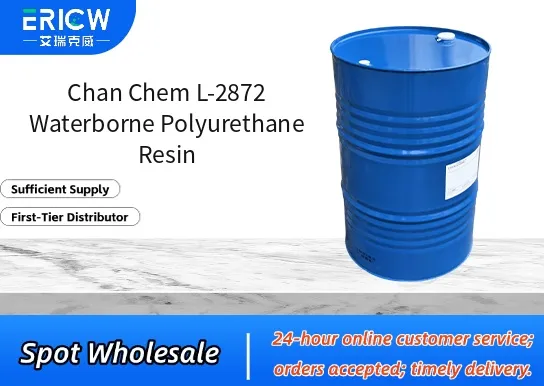
Excellent film-forming capability with high gloss and clarity after drying.
Low VOC content (< 50 g/L), compliant with stringent environmental regulations including EU REACH and US EPA standards.
Good hydrolytic stability and storage stability (≥12 months at 5–35°C in sealed container).
Superior flexibility and abrasion resistance, maintaining performance across wide temperature ranges.
Easy integration with acrylic emulsions, cellulose derivatives, and common water-based additives.
High-performance waterborne leather finishing topcoats for footwear and upholstery.
Flexible packaging coatings requiring solvent-free barrier and seal integrity.
Industrial wood coatings for furniture and cabinetry where low odor and rapid recoatability are critical.
Textile coating binders for technical fabrics requiring stretch recovery and wash-fastness.
Water-based adhesives for laminating PET, PVC, and nonwovens in automotive interior applications.
| Chemical Type | Anionic aliphatic polyurethane dispersion |
| Product Form | Opaque white to light yellow liquid |
| Appearance | Homogeneous milky dispersion, no sediment or separation |
| Solids Content (wt%) | 30.0 ± 1.0% |
| pH (at 25°C) | 7.8 – 8.5 |
| Viscosity (mPa·s, Brookfield RVT, #2 spindle, 20 rpm) | 150 – 400 |
| Minimum Film Formation Temperature (MFFT) | 12 – 16°C |
| Primary Applications | Topcoats, flexible coatings, laminating binders, textile finishes |
Q1: What are the primary application areas for Chan Chem L-2872?
A: Chan Chem L-2872 is widely used in high-performance waterborne coatings for flexible substrates, including synthetic leather finishing, textile coatings, and soft-touch industrial finishes where excellent film flexibility, abrasion resistance, and low-temperature film formation are required.
Q2: Can L-2872 be blended with other waterborne resins or additives?
A: Yes, L-2872 demonstrates good compatibility with many acrylic emulsions, waterborne polyesters, and common coalescing agents, defoamers, and rheology modifiers—though compatibility testing under actual formulation conditions is recommended prior to full-scale use.
Q3: How does L-2872 perform in terms of drying time and film formation?
A: L-2872 forms continuous, cohesive films at ambient temperatures with moderate drying speed; final film properties—including hardness and chemical resistance—develop progressively over 24–72 hours depending on film thickness, humidity, and air circulation.
Q4: Is L-2872 suitable for low-VOC or regulatory-compliant formulations?
A: Yes, as a waterborne polyurethane dispersion, L-2872 contributes to significantly reduced VOC content in finished coatings and aligns with global trends toward more sustainable coating systems—formulators should verify compliance with target regional regulations through full formulation assessment.
Contact With Us:
E-mail: wangxingqiang@ericwchem.com
Have a Questions? Call Us:
Add:
Building A1, Jiete Industrial Park, Huangpu District, Guangzhou City, Guangdong Province, China