English
 Español
 tiếng việt
 русский
Low-VOC, environmentally compliant formulation meeting stringent global emissions regulations.
Excellent film-forming properties with high flexibility and crack resistance after drying.
Superior adhesion to diverse substrates including leather, textiles, and synthetic fabrics.
Good chemical resistance to dry cleaning solvents and mild household detergents.
Optimized for high-shear stability in industrial coating and finishing equipment.
Topcoats for premium fashion and automotive leather finishing.
Flexible coatings for technical textiles requiring breathability and durability.
Water-based laminating adhesives in composite fabric production.
Surface modifiers for nonwovens used in medical and hygiene applications.
Base resin for eco-friendly textile printing pastes and binder systems.
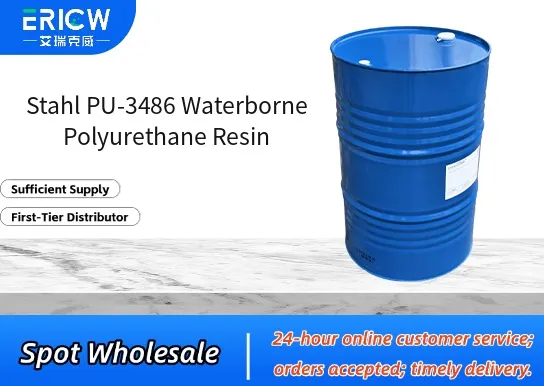
| Chemical Type | Aliphatic waterborne polyurethane dispersion |
| Product Form | Opaque white liquid |
| Appearance | Homogeneous milky dispersion |
| Solids Content (wt%) | 32–34% |
| pH | 7.5–8.5 |
| Viscosity (mPa·s, Brookfield RVT, #3 spindle, 20 rpm) | 1,500–3,500 |
| Minimum Film Formation Temperature (MFFT) | 15–20 °C |
| Storage Stability (at 5–30 °C) | ≥6 months in sealed original container |
Q1: What are the primary application areas for Stahl PU-3486?
A: Stahl PU-3486 is widely used in high-performance waterborne coatings and finishes for leather, textiles, and synthetic materials—particularly where excellent film flexibility, abrasion resistance, and low-temperature performance are required.
Q2: Is Stahl PU-3486 compatible with other waterborne resins or additives?
A: Yes, Stahl PU-3486 demonstrates good compatibility with common waterborne acrylics, polyurethane dispersions, crosslinkers, and rheology modifiers—though compatibility should always be verified experimentally in the final formulation.
Q3: How does Stahl PU-3486 perform in terms of film formation and drying behavior?
A: It forms continuous, cohesive films at ambient temperatures and exhibits rapid initial drying, supporting efficient production throughput—especially in spray, dip, or roll-coating processes on flexible substrates.
Q4: Can Stahl PU-3486 be used in formulations requiring low VOC content?
A: Yes—it is a waterborne system with inherently low volatile organic compound content, aligning well with regulatory expectations for sustainable, eco-conscious coating solutions.
Contact With Us:
E-mail: wangxingqiang@ericwchem.com
Have a Questions? Call Us:
Add:
Building A1, Jiete Industrial Park, Huangpu District, Guangzhou City, Guangdong Province, China