English
 Español
 tiếng việt
 русский
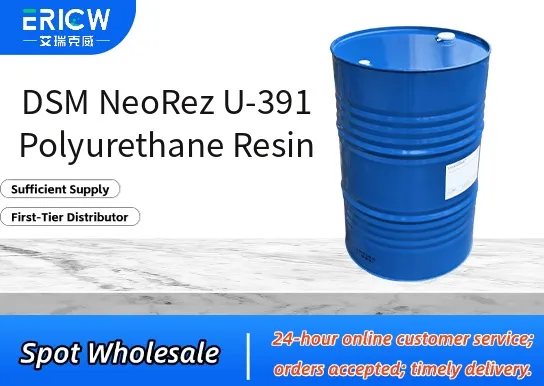
Waterborne anionic polyurethane dispersion with excellent film-forming properties.
Low VOC and compliant with stringent environmental regulations including EU REACH and US EPA guidelines.
Outstanding flexibility, abrasion resistance, and adhesion to diverse substrates including plastics, metals, and coated papers.
Good hydrolytic stability and storage stability at ambient temperature (up to 12 months in sealed container).
Compatible with common coalescents, crosslinkers, and water-based additives for formulation flexibility.
High-performance water-based leather coatings for footwear and upholstery.
Flexible packaging laminating adhesives requiring clarity and heat-seal compatibility.
Industrial protective topcoats for plastic components in automotive interiors.
Textile finishing agents delivering durable soft handle and wash-fastness.
Water-based wood finishes where low odor and rapid dry-through are critical.
| Chemical Type | Anionic aliphatic polyurethane dispersion |
| Product Form | Aqueous dispersion |
| Appearance | Opaque white to off-white liquid |
| pH (at 25°C) | 7.5 – 8.5 |
| Solids Content (wt%) | 30.0 – 32.0% |
| Viscosity (mPa·s, Brookfield RVT, #2 spindle, 20 rpm) | 50 – 200 |
| Particle Size (D50, nm) | 80 – 120 |
| Minimum Film Formation Temperature (MFFT) | ~15°C |
Q1: What is the primary function of NeoRez U-391 in waterborne coating formulations?
A: NeoRez U-391 is a self-emulsifying, anionic polyurethane dispersion designed to enhance film formation, flexibility, and mechanical durability—particularly in high-performance architectural, industrial, and protective coatings where toughness and low-temperature coalescence are critical.
Q2: Can NeoRez U-391 be used in combination with acrylic dispersions?
A: Yes, NeoRez U-391 exhibits excellent compatibility with many common acrylic dispersions and is frequently blended to improve block resistance, scrub resistance, and substrate adhesion without compromising gloss or clarity in clearcoat systems.
Q3: How should NeoRez U-391 be incorporated into a formulation to avoid destabilization?
A: It is recommended to add NeoRez U-391 during the let-down stage, after pH adjustment and under gentle agitation. Avoid direct addition to highly acidic or strongly cationic components, and always verify compatibility via small-scale trials before full-scale production.
Q4: Is NeoRez U-391 suitable for low-VOC or zero-VOC coating systems?
A: Yes—NeoRez U-391 is supplied as a water-based dispersion with negligible VOC content and is widely selected for formulating compliant low-VOC architectural paints, maintenance coatings, and specialty finishes targeting green building standards.
Contact With Us:
E-mail: wangxingqiang@ericwchem.com
Have a Questions? Call Us:
Add:
Building A1, Jiete Industrial Park, Huangpu District, Guangzhou City, Guangdong Province, China