English
 Español
 tiếng việt
 русский
Low-VOC, environmentally compliant formulation meeting global regulatory standards including REACH and EPA guidelines.
Excellent film-forming capability with high gloss retention and superior clarity after drying.
Outstanding flexibility and abrasion resistance, maintaining performance under repeated mechanical stress.
Good compatibility with acrylic emulsions and water-based crosslinkers for customized formulation flexibility.
Stable dispersion in water with broad pH tolerance (6.5–8.5) and minimal sensitivity to hard water ions.
High-performance water-based leather finishes for footwear and upholstery.
Topcoats and clear coats for wood furniture and cabinetry requiring durability and aesthetic clarity.
Flexible coatings for synthetic fabrics and technical textiles demanding breathability and wash-fastness.
Industrial maintenance coatings for metal substrates where corrosion inhibition and low-emission processing are critical.
Base resin in eco-friendly inkjet receptive coatings for decorative laminates and digital printing substrates.
| Chemical Type | Aliphatic waterborne polyurethane dispersion |
| Product Form | Opaque white liquid |
| Appearance | Homogeneous milky dispersion, no sedimentation |
| Solids Content (wt%) | 30 ± 1% |
| pH Value | 7.2 ± 0.3 |
| Viscosity (mPa·s, Brookfield RVT, #3 spindle, 20 rpm) | 150–300 |
| Density (g/cm³ at 25°C) | 1.02–1.04 |
| Minimum Film Formation Temperature (MFFT) | 12–15°C |
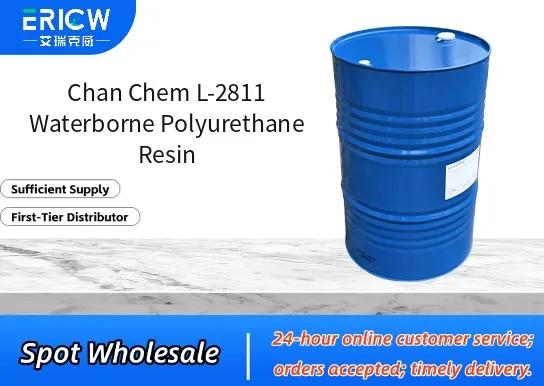
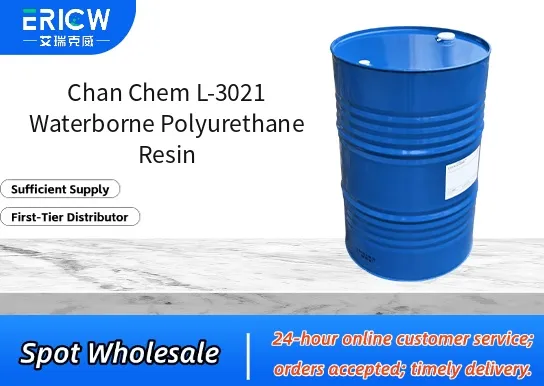
Q1: What are the primary application areas for Chan Chem L-3021?
A: Chan Chem L-3021 is widely used in waterborne coatings for flexible substrates—including synthetic leather, textiles, and automotive interior trim—where excellent film flexibility, abrasion resistance, and low-VOC performance are required.
Q2: Is L-3021 compatible with other waterborne resins or additives?
A: Yes, L-3021 demonstrates good compatibility with common waterborne acrylics, polyacrylates, and crosslinkers such as aziridines or carbodiimides. Compatibility should always be verified in the final formulation through stability and performance testing.
Q3: How does L-3021 perform under high-humidity curing conditions?
A: L-3021 forms robust films even under elevated humidity due to its optimized particle morphology and coalescence behavior. However, extended drying times may occur at RH >85%, and controlled air circulation is recommended for optimal film formation.
Q4: Can L-3021 be used in heat-sensitive substrates?
A: Yes, L-3021 is formulated for ambient or low-temperature curing (typically below 80°C), making it suitable for heat-sensitive materials such as coated fabrics, foams, and certain plastics without thermal degradation risks.
Contact With Us:
E-mail: wangxingqiang@ericwchem.com
Have a Questions? Call Us:
Add:
Building A1, Jiete Industrial Park, Huangpu District, Guangzhou City, Guangdong Province, China