English
 Español
 tiếng việt
 русский
Excellent film-forming capability with high clarity and gloss retention.
Superior mechanical resistance, including abrasion, scratch, and impact performance.
Low VOC content compliant with stringent environmental regulations (e.g., EU REACH, US EPA).
Good compatibility with acrylic dispersions and other waterborne resins for hybrid formulations.
Stable storage life (>12 months at 5–30 °C) without viscosity drift or phase separation.
High-performance waterborne wood coatings for furniture and cabinetry.
Interior architectural coatings requiring durability and low odor.
Plastic coatings for rigid substrates such as ABS, PC, and PVC.
Industrial maintenance coatings for metal and concrete surfaces.
Coatings for flooring systems requiring chemical and wear resistance.
| Chemical Type | Aliphatic waterborne polyurethane dispersion |
| Product Form | Opaque white to slightly bluish liquid |
| Appearance | Homogeneous dispersion, no sedimentation |
| Solids Content (wt.%) | 35 ± 1 |
| pH | 7.5 – 8.5 |
| Viscosity (mPa·s, Brookfield RVT, #2 spindle, 20 rpm, 25 °C) | 150 – 400 |
| Density (g/cm³, 25 °C) | 1.02 – 1.06 |
| Minimum Film Formation Temperature (MFFT) | ≈ 15 °C |
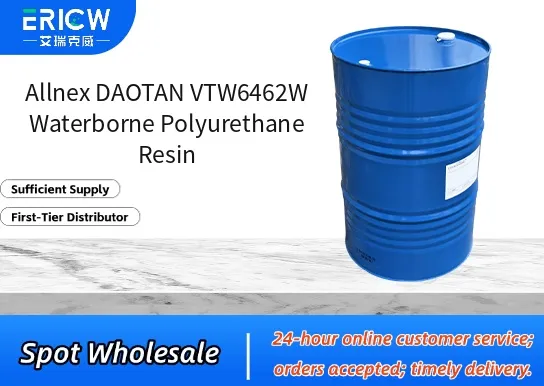
Q1: What are the primary application areas for DAOTAN VTW6462W?
A: DAOTAN VTW6462W is primarily formulated into high-performance waterborne coatings for flexible substrates—especially in textile finishing, synthetic leather topcoats, and soft-touch automotive interior coatings where excellent film flexibility, abrasion resistance, and low-temperature film formation are required.
Q2: How does VTW6462W compare to solvent-based polyurethane resins in terms of performance and processing?
A: VTW6462W delivers comparable mechanical properties—including tensile strength, elongation, and adhesion—to many solvent-based alternatives, while enabling significantly lower VOC emissions and improved workplace safety. It requires no organic co-solvents for stable dispersion and offers good compatibility with common waterborne additives and crosslinkers.
Q3: Is VTW6462W compatible with common waterborne acrylic or polyester dispersions?
A: Yes—VTW6462W exhibits broad compatibility with typical waterborne acrylic, polyester, and hybrid dispersions. Blending ratios should be optimized based on desired film properties, but phase stability is generally achieved without special surfactants or pH adjustment in standard formulation ranges.
Q4: What type of crosslinking is recommended to enhance chemical resistance and durability?
A: For enhanced crosslink density, VTW6462W responds well to ambient-cure or heat-activated aziridine, carbodiimide, or blocked polyisocyanate crosslinkers. Selection depends on end-use requirements such as pot life, cure schedule, and regulatory constraints—formulators commonly evaluate performance trade-offs between reactivity and storage stability.
Contact With Us:
E-mail: wangxingqiang@ericwchem.com
Have a Questions? Call Us:
Add:
Building A1, Jiete Industrial Park, Huangpu District, Guangzhou City, Guangdong Province, China